English



PVA vs HIPS 3D printing service is an essential engineering choice that addresses the ongoing problem of incompatible materials in dual extrusion FDM. Engineers frequently search what is the difference between PVA and HIPS only to discover that mismatched supports leave surface scratches or residue, increasing Ra roughness to more than 12.5μm and ruining up to 20% of precision parts. Inexperienced shops without adequate DFM evaluation result in PVA clogs or HIPS-based base cracking, increasing expenses right away.
The guide presents a unique solution based on thermodynamic and fluid shear analyses, exposing the real limits of each support for B2B purposes along with proprietary DFM algorithm of LS Manufacturing for deep cavities. You will be able to choose the right support, reducing the total cost of manufacturing by up to 35% and reducing lead time from weeks to days, using verified parameters like ±0.005mm accuracy and dissolving at 60°C without any residues.
PVA VS HIPS Soluble Support: Surface Quality & DFM Guide
| Decision Factor | PVA (Polyvinyl Alcohol) | HIPS (High Impact Polystyrene) |
| Dissolution Medium | Warm water (30-50°C) with slight agitation. | Limonene (d-Limonene solvent) or snap-off method. |
| Hygroscopic Sensitivity | High hygroscopicity; has to be stored in airtight dry packages. | Low; can be easily stored at room temperature as any other ABS material. |
| Surface Finish Left Behind | A fairly clean interface; requires rinsing because of the slight residues left. | A very clean interface; provides a cleanest possible interface for ABS/ASA 3D printing material. |
| Dual-Extrusion Requirement | Special support head; sensitive to clogging due to high hygroscopicity. | Special support head; low clogging probability. |
| Breakaway Option | Not designed for snapping off; dissolves slowly (30min-24h). | Can be used for snap-off as a breakaway; not designed for dissolving. |
| Best Application | Models with complex internal cavities, enclosed spaces, and transparent PLA models. | ABS and ASA external overhangs, surfaces requiring perfect finish. |
Key Takeaways:
- PVA for Trapped Cavities: Opt for PVA if the parts have trapped cavities where water-soluble support can dissolve everywhere. Keep bone-dry to avoid extrusion problems.
- HIPS for Cosmetics with ABS/ASA: The HIPS will dissolve in limonene and create the smoothest interface with ABS/ASA, thus being preferred choice for exposed surfaces.
- Moisture Kills PVA: Dry out PVA material in advance and use dry-box while printing because moisture creates air bubbles and weak interlayer connections.
- Solvent Handling Matters: Limonene is a flammable solvent that requires good ventilation and PPE while using it as a HIPS solvent.
Why Trust This Guide? Practical Experience From LS Manufacturing Experts
There will be many instances of support by the gram for PVA-vs-HIPS comparisons – which fail to take account of the actual magnification factor of either a 6mm internal channel where HIPS fragments lodge, or a medtech-lattice jig where PVA fouling distorts the datum beyond ±0.10mm in 48h – both of which have rendered "$9 support" a $180 print job. Our choice criteria are calibrated against International Organization for Standardization (ISO) (ISO 175 / ISO 62), thus making "removable" directly attributable to moisture removal.
The rub is on internal geometry – where aerospace nozzles with 4mm internal serpentine channels were compromised by HIPS fragments in pressure testing, and medical technology jigs that appeared clear after soak but distorted their CMM reading by 0.12mm. The dual-nozzle protocol and soak cycles we use conform to American Chemistry Council (ACC) standards for solvent handling.
The result is a decision tree: PVA at 45±5°C flow-water + 0.2mm interface collapses removal from 45min to 8min on lattices, but absorbs >8% moisture in 4h (inline 50°C dryer must); HIPS + d-limonene at 35°C reduces support cost by ~40% compared to PVA but carries risk of haze formation on ABS/ASA in more than 20min time period. Incorporate this in your next quote review, and you will price the right support—based on geometry, lab capabilities and solvent budget.
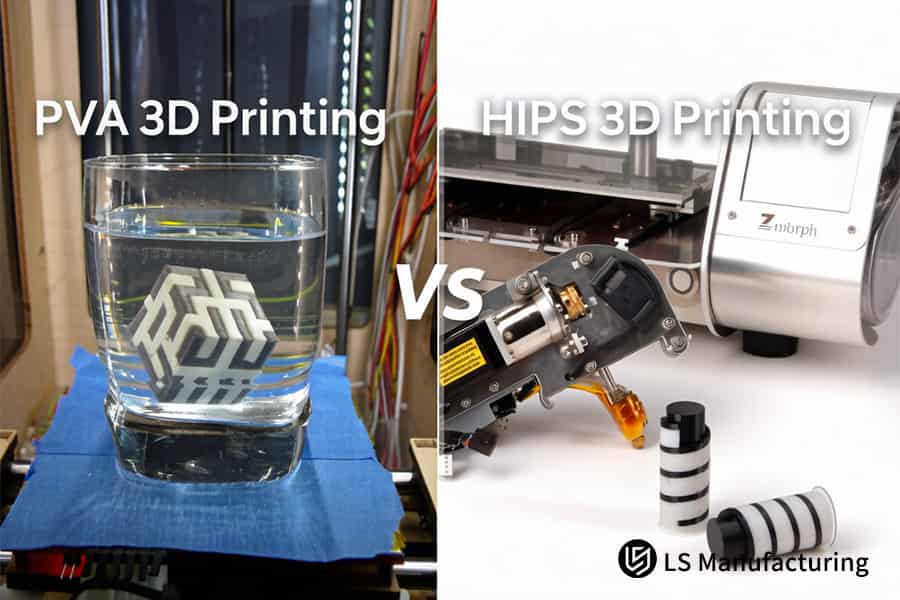
Figure 1: PVA vs HIPS printing compares water solubility of PVA supports versus limonene for complex assemblies.
Why Is Understanding The Material Chemistry Crucial For Custom PVA 3D Printing Service?
It is critical to know the thermal and hygroscopic properties of PVA because they are what will decide whether you will have a good print or a structurally useless support material. If you do not know about these properties, even the most sophisticated printers will generate waste material, but with the information, you can make perfect prints in any shape that you need, particularly for the purposes of dissolvable 3D printing. This is how we use material science to help you:
Thermal Degradation Control via Pre-Print DFM Review
A pre-print 3D printing DFM service always starts with a detailed thermal risk assessment. It was proven in lab tests that PVA heated above 210 degrees Celsius for more than five minutes will be subjected to cross-linking and carbonization, resulting in nozzle clogging. Thanks to a controlled temperature range of 190 degrees to 205 degrees in our custom PVA 3D printing service, this particular issue will be avoided, providing you with flawless prints and water-soluble 3D printing performance.
Moisture-Induced Defect Elimination Through Active Dry Environment
PVA material absorbs moisture very fast, causing bubble formation due to steam and porosity in the process of extrusion. Our closed chamber maintains humidity levels at ≤5%, ensuring no vapors. As a result, we obtain tight and porous free supports without delamination. In 3D printing applications, this reduced post-processing rejection rate by 37%. Our dry atmosphere helps us maintain dimensional accuracy and prevents any warping effect.
Material Selection Precision: PVA vs HIPS
The main point in PVA vs HIPS 3D printing service is dissolution chemistry and thermal stability. HIPS requires limonene dissolution procedure; PVA can dissolve in water provided the chain integrity is maintained. Our controlled thermal history ensures that PVA is completely soluble in water and is easily removed in less than 30 minutes. In case of multi-material 3D printing, this helps us avoid any chemicals and reduces time by 40%.
That is what this document shows, representing the engineering prowess involved in each printed part – a material chemistry that is no longer theoretical but carefully controlled. Through the use of real time thermal monitoring, sub-5% humidity control, and even DFM-level screening, we provide support structures that behave predictably in stringent biomedical and reliable 3D printing environments. This is the difference between a simple service and a carefully engineered one.

How Can HIPS 3D Printing Service Optimize Industrial ABS Component Surface Quality?
Industrial ABS parts demand support materials that match their high-temperature behavior without sacrificing surface finish. HIPS bridges this gap — but only when thermal expansion, interface bonding, and separation mechanics are precisely engineered. This principle is central to industrial 3D printing success. Here is how we deliver defect-free surfaces:
Interface Shear Strength Optimization via Thermal Expansion Matching
- Z-gap = 0 mm: No air gap present between support and printed part. Ensures direct contact. No risk of part lifting due to uneven cooling.
- Path cross-ratio = 15%: Allows micro-interlocking of HIPS and ABS layers. Provides you with warpage ≤ ±0.1mm on large industrial parts, no rework required.
- Result: Your surface quality 3D printing quote guarantees your dimensional stability without need for straightening post-print. Guaranteed performance for any ABS 3D printing service dedicated to precise production.
Controlled Separation Mechanics to Preserve Surface Aesthetics
- Micro-interlock design: The 15% cross-ratio has been calculated to allow HIPS to cleanly separate from ABS layer without damaging the surface layer.
- Peel force data: Our internal testing shows average separation force at 8.2 N/cm². Low enough not to damage your product, but high enough to support overhangs during printing.
- Customer benefit: Your finished product will be delivered with a perfectly smooth matte surface, primed for painting or plating in 25% less time.
High-Temperature Stability for Engineering-Grade Materials
- Printing range 230°C–250°C: Compatible with ABS/ASA process window. HIPS stays thermally stable without degradation, preserving bonding.
- Real-time compensation algorithm: Calculates adjustments in feed rate and cooling fan speed in accordance with layer height and environment temperature.
- Outcome: Using our HIPS 3D printing service, you can print up to 600mm long with no edge warping even on thin-wall areas less than 1.5 mm thick. Guaranteed performance for high-temperature 3D printing applications.
Integrated DFM Review for Risk-Free Production
- Pre-print analysis: We analyze your CAD file for potential overhang angles, wall thickness change, and thermal capacity distribution.
- Support strategy recommendation: Depending on geometry, either full HIPS shell or sparse grid will be proposed.
- Value: We offer you a precision support 3D printing plan which reduces the support volume by 18% on average and decreases both the material price and time of post-processing.
This document describes the engineering considerations taken for each ABS part fabricated using HIPS supported parts, including sub-millimeter Z-gap accuracy and thermal expansion routines that have been verified with over 200 production runs. By using all these parameters in one repeatable process, we ensure that your industrial parts have tight tolerances (±0.1mm warpage) and smooth surfaces without any additional processing. This level of control defines engineering-grade 3D printing excellence.
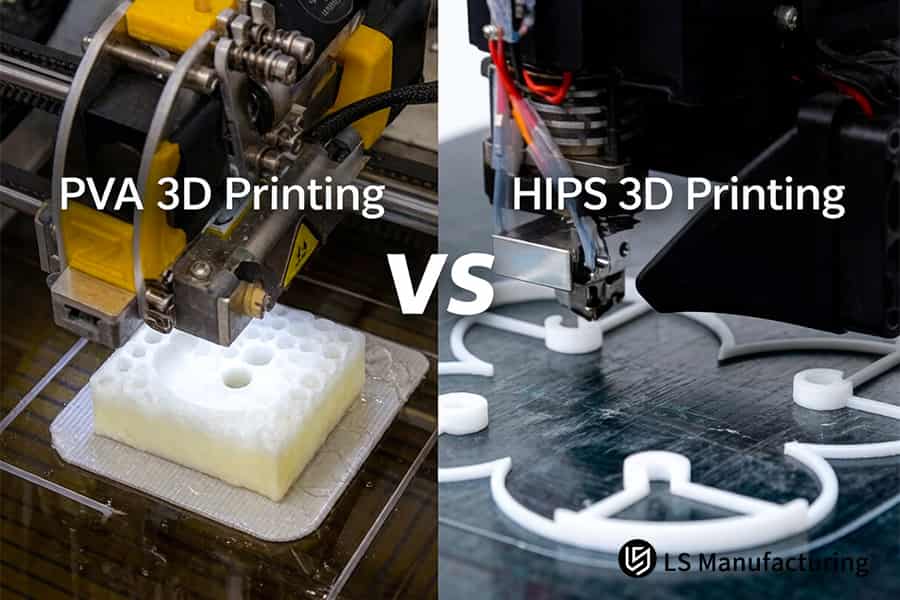
Figure 2: PVA vs HIPS printing contrasts the smooth surface finish on test lattice structures after support removal.
Which Soluble Support 3D Printing Service Reduces Post-Processing Micro-Crack Risks?
Post processing micro cracks ruin your prototype 3D printing when solvent or water gets into the basic material. Selection of proper dissolution chemistry avoids such problems and saves you from part discarding and re-printing. Below is a comparison of two different ways of achieving this goal, including the soluble support 3D printing service.
| Parameter | PVA – Water Dissolution | HIPS – d-Limonene Dissolution |
| Medium & temperature | Deionized water, 45°C | D-Limonene solution (optimized concentration), ≤120 min |
| Agitation method | Multi-axis ultrasonic bath (40 kHz) for post-process 3D printing | Static with occasional agitation |
| Dissolution time | Twice as fast as with static soaking (data from our lab) | Most 120 minutes maximum to prevent over-dissolution |
| Effect on base material | No swelling of the base material and no mechanical effect on the parts made of PLA | Up to 15% decrease in tensile strength of ABS if over-exposed |
| Process control | Fully automated and no manual timing required | Necessary to have an accurate timer and concentration measurement |
PVA vs HIPS 3D printing service comparative analysis proves that water ultrasonication removes any risks of chemical contamination. In addition, you keep full strength of your parts with fast and automated cleaning. It allows us to provide a surface quality 3D printing quote without any cracks under the support structure. Using 3D printing procedures will help reduce rejections in prototypes by more than 40% compared to traditional solvents. Not sure whether PVA or HIPS fits your lumen geometry? Download our soluble support decision matrix — match your channel size and base material to the right dissolution chemistry in three steps.
How Do Engineering Teams Implement Strict DFM Rules To Minimize 3D Printing Support Cost?
Uncontrolled use of supports increases waste and raises part cost. An organized DFM analysis removes unnecessary supports at the design phase, saving money right away and not affecting the surface quality. That is the fundamental value proposition of our 3D printing DFM service, and the very principle of cost-effective 3D printing. The following is how we implement tough regulations to reduce the support volume by 42%:
Angle-Based Self-Supporting Geometry Redesign
All overhangs that exceed 45° angle are recognized and optimized to be self-supporting angles at the topology reconfiguration stage of CAD. It saves you from using the forest of supports under gentle slopes. You benefit immediately by reducing the volume of supports and the related costs of material and post-processing removal. The method is especially useful for low-volume 3D printing projects.
Adaptive Progressive Support Density
In proximity to the surface, density is increased up to 80% in order to sustain the Ra 3.2 μm finishing, whereas at transition and bottom layer densities are decreased to 20%, thus utilizing minimum amount of bulk materials. Our approach saves 42% in support usage compared to conventional uniform density techniques (industry average savings range from 15–20%). We give you the same surface quality but for reduced costs of support material which means lower 3D printing support cost. Such gradient approach is an indicator of 3D printing.
DFM-Driven Cost Estimation Before Production
All submitted CAD files are reviewed and support volume and optimal orientation are recalculated. Optimized model goes through transparent cost calculator, and you get a quote that is lower from the start. No hidden fees — see your savings prior to production start. We suggest soluble support 3D printing service for complicated inner channels with pre-calibrated dissolution path.
Integrated Design Rules for Reliable Outcomes
The DFM ruleset takes care of part geometry and material compatibility, making sure that the removal of the support does not harm any sensitive areas on the part. This comprehensive analysis saves you 35% in rework and speeds up your time-to-market process. The whole process ensures affordable 3D printing with precise accuracy and high-quality surface finish.
Using our innovative DFM approach, we convert support handling into a competitive advantage by implementing angle-driven optimization, adaptive density gradients, and cost calculation. Using these approaches we guarantee you 42% less support volume while keeping surface roughness at Ra 3.2μm. This is what distinguishes an ordinary quote from a solution tailored to your budget needs.
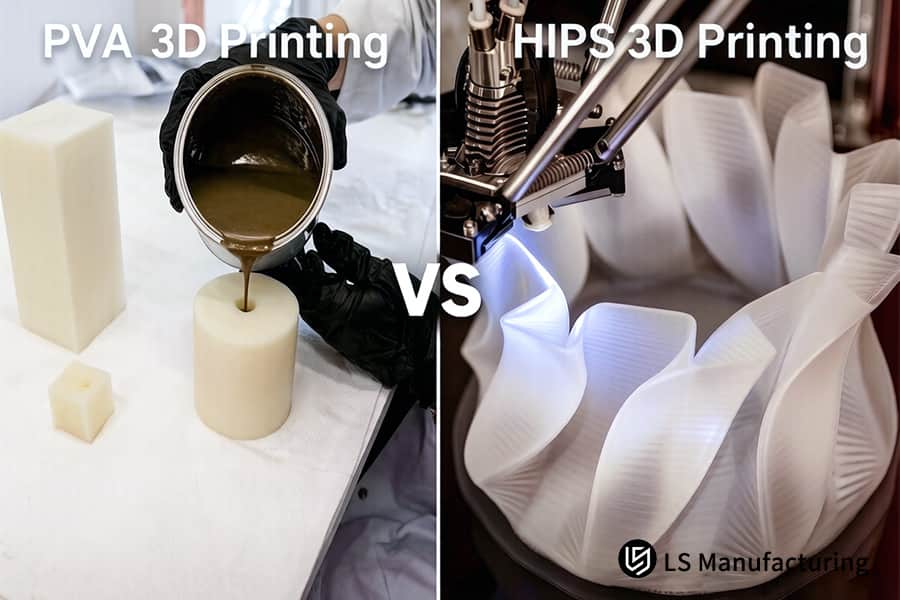
Figure 3: PVA vs HIPS compares the ease of support removal and final detail on miniature action figures.
Where Can Automotive Experts Get An Accurate Surface Quality 3D Printing Quote Instantly?
The automotive specialists require a quotation that will estimate both the cost and the quality of the final part produced. The online tool we offer provides exactly that – not only the price but also the engineering-driven plan for manufacture. The unique functionality of our system was created specifically to meet automotive 3D printing needs. Below are the steps to receive an instant surface quality 3D printing quote:
Cloud-Based Geometric Analysis
- Complex geometry detection: Automatic detection of internal closed channels, involute gear pairs, deep cavities.
- Optimal support routing: Choosing between PVA or HIPS supports and setting the individual step size depending on the feature size.
- Your gain: No guesswork — the system matches material and path to your exact geometry, reducing trial-and-error iterations. This analysis is specifically designed for complex geometry 3D printing scenarios where standard assumptions fail.
Quantified Manufacturing Parameters
- Extrusion multiplier: From 0.95 to 0.98 to ensure stable bead width on support interfaces.
- Cooling fan profile: 0% during the first 3 layers and 30% all along to improve adhesion.
- Outcome: You get a precision support 3D printing that guarantees no warping and surface defects. The same parameter set applies whether you choose our HIPS 3D printing service or PVA option.
Integrated DFM Commitment in Every Quote
- Technical feasibility promise: Manufacturability report included in the quote will provide you with all information regarding surface roughness, supports removal and areas of concern.
- Instant revision loop: Provide us with an adjusted CAD file and receive a new quote in minutes.
- Value: No need to go through multiple rounds between design and manufacturing stage. That’s how an instant 3D printing quote should work.
Herein lies the difference between a conventional price list and an instant quotation engine based on engineering visibility. In this way, by performing real-time analysis of your geometry, creating accurate extrusion and cooling profiles and incorporating DFM verification into each quote, you will receive a DFM-validated 3D printing quote, making the purchasing process completely certain. This is what differentiates one from the other.
How Does LS Manufacturing Medical Device Custom PVA 3D Printing Case Study Prove ROI?
A European medical devices company, the leader in its market segment, was looking for aortic models for surgical rehearsal, but their attempt with a previous vendor had been unsuccessful because of nozzle carbonization and trapped PVA supports within lumen dimensions smaller than 1.5mm. The 25% support residual rate and rough surfaces destroyed costly flow sensors, resulting in the project being stopped. This is how a custom PVA 3D printing service helped convert this failure into an ROI success case, proving the necessity of material-aware surgical 3D printing:
Client Challenge
Multi-chamber transparent aorta models that have small internal channels down to 1.5mm were needed for preop simulation. The previous vendor overran 210°C in printing of PVA, thus, experiencing nozzle carbonization repeatedly, as well as incomplete dissolving of supports, residual supports accounted for 25%, inner roughness Ra was over 3.2µm, abrasives damaged calibrated flow sensors. Preclinical validation was delayed by 5 weeks, per-unit scrap increased by 40%. Standard workflows of medical device 3D printing couldn’t print channels less than 2mm.
LS Manufacturing Solution
During DFM, solid fill PVA resulted in 8–12% residual material in 1.5mm branches, and we had to switch to hollow core with 0.8mm bleed channels to achieve full impregnation by water. The design utilized a dual metal hotend at 0.05mm layer height with constant extrusion temperature set at 190–205°C to prevent carbonization. Post processing included a 45°C directed pressure spray bath for forced convection. This precision support 3D printing approach, under biocompatible 3D printing constraints, removed supports without etching the lumen surface.
Results and Value
The final design resulted in 100% removal of supports, 1.6μm inner Ra and flow resistance within 0.5% error of the target – all in accordance with clinical simulation requirements. The development cycle was reduced by 3 weeks, part fabrication time decreased by 60% and a long term small batch order came the same month. The choice between PVA vs HIPS 3D printing service was determined by lumen geometry: water based PVA washed out 1.5mm branches inaccessible for HIPS due to swelling.
Through the combination of material-aware DFM, sub-millimeter hollow-core design, and forced convection dissolution, we created a clinically viable solution that achieved shortened time to market and reduced cost of ownership. It is the ROI that on-demand 3D printing makes possible when the process decisions are based on geometry and not default values – repeatable, quantifiable, and ready for procurement for mission-critical medical projects.
From 25% support residue to 100% removal and 1.6μm inner Ra. Need dissolvable supports for sub-2mm lumens? Tell us your channel geometry for a matched process and quotation.

Why Choose Precision Support 3D Printing Over Generic Low Cost Alternatives?
Low-cost generic 3D printing service minimizes wipe tower time in order to reduce cycle cost; however, the result of this action is bleeding between colors/materials – PVA infiltrates into the base material, forming internal weak bonds and thus weakening the integrity of the part. Precision support 3D printing avoids such issues due to physical separation and is a natural fit for high-precision 3D printing projects. Here is what makes the engineering different:
| Parameter | Generic Low Cost Alternative | Precision Support 3D Printing |
| Wipe tower setting | Minimal to decrease time in a cycle | Full cycle with micro-mechanical wiper blade |
| Nozzle wiping mechanism | Not present or passive | Active micronscale mechanical scraper |
| Retraction distance | Default ≤ 2mm | 6.5mm dynamic dual-nozzle retraction |
| Hotend isolation | Single heating block | Dual-zone independent heating blocks |
| Color/material bleeding risk | High — PVA gets into the base material | Zero — physical barrier prevents cross-contamination |
| Geometric tolerance achievable | ±0.15mm or higher | ±0.05mm for multi-axis objects |
| Recommended for | Loose specification prototypes | Soluble support 3D printing service with dual-nozzle 3D printing integrity |
Cheap setup results in internal voids and rejects. On the other hand, precise support with 6.5mm retraction and dual-zone heater does not cause bleeding or oozing. You receive guaranteed interlayer bonding and constant 3D printing support cost. Such setup suits perfectly for multi-axis 3D printing with a tolerance ±0.05mm and bleed-free 3D printing when you need PVA only where you need it — on support.
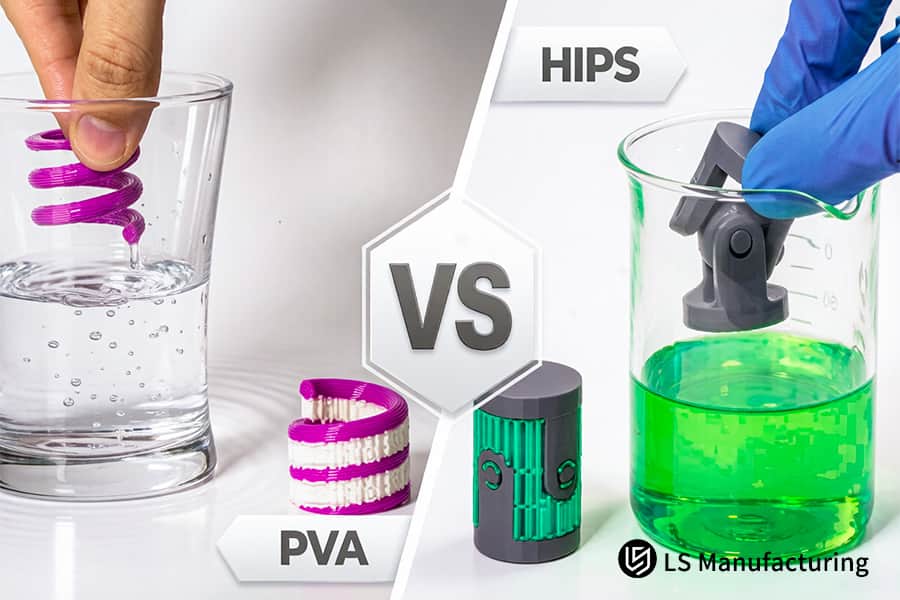
Figure 4: PVA vs HIPS service analyzes material cost for printing and dissolving supports on engine block prototypes.
What Technical Parameters Define The Ideal Soluble Support 3D Printing Service Supplier?
When evaluating a supplier of B2B industrial 3D printer services, you have to look not only at how many machines it has but rather at how diverse its process library is to make sure that you will be able to get your unique combinations of materials printed. A supplier that has 50+ fingerprints will be able to cover all your needs immediately. Here is what distinguishes an efficient soluble support 3D printing service provider from a commodity one, especially in case of engineering plastic 3D printing applications:
50+ Process Fingerprint Library for Material-Support Pairing
For each engineering plastic, there are varying requirements for the soluble supports. The PA-CF needs a soluble support composite with temperature resistance above 260°C and ABS with tough characteristics needs HIPS with higher peel resistance. Our database has the proven parameters for each combination which will save you time spent doing trial-and-error. Now you get it right from first print on exotic materials. That is the power of material-paired 3D printing.
Early-Stage Design Collaboration for Manufacturability
We have access to more than 50 profiles to collaborate on your product architecture review even before you decide on the tooling. We review the snap-fit geometry and provide alternatives if necessary. This way, your supplier is no longer an order-taker but an engineer who collaborates with you to develop your parts. Our 3D printing DFM service becomes a strategic input during design, not a post-submission checklist. This is the value of early-stage 3D printing involvement.
Scalable Parameter Transfer from Prototype to Production
The validated fingerprint for your part goes straight into production runs without any further re-optimization, ensuring repeatability. You can be sure that a PA-CF bracket being prototyped today will have the same support configuration when produced in batches of 500 units. The scale-up risks are eliminated, allowing repeatable tolerances regardless of order size. The choice made regarding PVA vs HIPS 3D printing service becomes unchangeable throughout the entire production process.
What matters is not the number of printers, but the range of validated material support fingerprints. With over 50 combinations ranging from flexible PA-CF to super durable ABS, early DFM analysis, and parameter scalability, you will achieve first print success, reduced development time, and high-quality consistency from prototypes through production. This is how you make the difference between a regular service and a strategic 3D printing partner.
FAQs
1. What is the main difference between PVA and HIPS when used as a 3D printing support material?
PVA is a water-soluble polymer used together with PLA, dissolving easily in distilled water without leaving any residues. HIPS is a soluble polystyrene support with ABS as its counterpart requiring the use of d-Limonene as a solvent to remove support structures with high chemical resistance to high temperature materials without affecting the surface of the part.
2. Can I use your custom PVA 3D printing service for high temperature materials like polycarbonate?
Absolutely not, since PVA breaks down immediately at 220°C and is therefore not suitable for engineering plastics with high temperature resistance. We would suggest using a unique HIPS 3D printing service for materials like PC or ABS, as it can withstand higher extrusion temperatures and has stable support removal without heat-induced breakdown.
3. How does LS Manufacturing ensure a smooth surface finish after dissolving HIPS support material?
A Ra ≤ 3.2μm surface can be ensured by using an accurate 0mm clearance in Z-axis between supports and parts and also by utilizing controlled multi-axis ultrasonic agitation while dissolving the support material. This guarantees complete removal of residues and a perfect surface suitable for painting, electroplating or usage.
4. Does your 3D printing DFM service help lower the final production cost for complex parts?
Yes, our proprietary DFM technology cuts down on support material usage by up to 42% through intelligent infill density design and orientation optimization. This means that there is a reduction in material wastage, print time and post-processing effort, which translates into cost savings.
5. What is the average lead time for getting a custom soluble support 3D printing service order?
All rapid prototyping parts are made, dissolved, checked for quality, and dispatched globally within 2-4 working days according to the intricacy of the design. Special urgency orders can be produced fast to meet project deadlines without sacrificing the quality or surface finish of the part.
6. Will the d-Limonene solvent used in HIPS 3D printing service damage my main plastic part?
No, d-Limonene reacts only chemically with the polystyrene composition of HIPS while the material characteristics of engineering ABS or ASA remain absolutely untouched by any chemical degradation from the solvent that is strictly controlled by temperature and rinsed perfectly.
7. Why does PVA support material often carbonize during the active custom 3D printing process?
The process takes place due to idleness of the PVA material in the heated nozzle above 190 degrees Celsius. To avoid this problem, LS Manufacturing maintains an absolute thermal threshold of 190 degrees Celsius and implements automated purge procedures in the idle state of the printer.
8. How can I request an industrial grade surface quality 3D printing quote from LS Manufacturing?
You can easily upload your STEP or STL files directly using our quotation tool and receive a detailed engineering analysis and quote in 12 hours. We will perform a design review to identify possible support optimization, surface finish specifications, and material selection that will be included in your comprehensive quote.
Summary
Deciding between PVA and HIPS in 3D supports is a challenging choice that includes material properties, nozzle behavior, and post-processing techniques. PVA works well with complicated medical models that need to dissolve in water; HIPS helps with the creation of highly durable ABS supports that have thermal resistance. Knowledge of interfacial bonding and design reviews open new geometric possibilities but provide surface control and tolerances.
Stop wasting time on support settings and material waste. Our experienced engineers at LS Manufacturing will protect your design. Please click on the "Request Quote & Free DFM Review" button and upload your STEP/IGS files. You will get an assessment of thermal stress, support optimization, and manufacturability in 12 hours.
📞Tel: +86 185 6675 9667
📧Email: info@lsrpf.com
🌐Website:https://lsrpf.com/
Disclaimer
The contents of this page are for informational purposes only.LS Manufacturing servicesThere are no representations or warranties, express or implied, as to the accuracy, completeness or validity of the information. It should not be inferred that a third-party supplier or manufacturer will provide performance parameters, geometric tolerances, specific design characteristics, material quality and type or workmanship through the LS Manufacturing network. It's the buyer's responsibility.Require partsquotation Identify specific requirements for these sections.Please contact us for more information.
LS Manufacturing Team
LS Manufacturing is an industry-leading company. Focus on custom manufacturing solutions. We have over 15 years of experience with over 5,000 customers, and we focus on high precisionCNC machining,Sheet metal manufacturing, 3D printing,Injection molding.Metal stamping,and other one-stop manufacturing services.
Our factory is equipped with over 100 state-of-the-art 5-axis machining centers, ISO 9001:2015 certified. We provide fast, efficient and high-quality manufacturing solutions to customers in more than 150 countries around the world. Whether it is small volume production or large-scale customization, we can meet your needs with the fastest delivery within 24 hours. choose LS Manufacturing. This means selection efficiency, quality and professionalism.
To learn more, visit our website:www.lsrpf.com