English



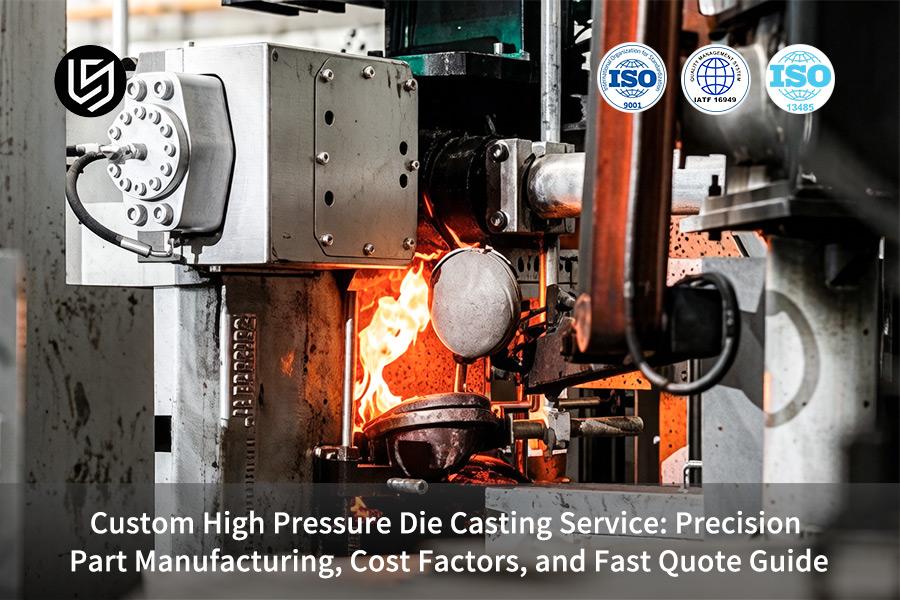
Custom high pressure die casting service is a precision process, it solves porosity in aluminum parts. Teams ask what is high pressure casting.
This model cuts costs by 30% to 50% for zero defects. It sets shot velocity within ±1%, fill time under 20 ms, and gate speed at 25 to 45 m/s.
Custom High Pressure Die Casting – Quick Reference For Precision Part Manufacturing
| Capability | Technology & Method | Performance Metric |
| Dimensional Precision | Servo injection + PQ² dynamic matching, CMM check per batch tolerance | Servo injection + PQ² dynamic matching, CMM check per batch tolerance |
| Porosity Elimination | Vacuum casting ≤30 mbar + real time adjustment of shot profile | Porosity <0.5% volumetrically, leakage testing >99.9% @ 0.3 MPa |
| Thin-Wall Capability | Injection pressure 80–120 MPa at 50 m/s; gate velocity 25–45 m/s | Minimum wall thickness 0.8 mm; fill time <20 ms; zero misrun defects |
| Tooling Life & Cost | H13 steel at HRC 48–52 + conformal cooling channels at 180±5°C | Die life >200,000 shots; per-part tooling cost reduced 40% |
| Material Options | Al (A380, ADC12, AlSi10MnMg), Zn (Zamak 3/5), Mg (AZ91D); low-Fe <0.15% | Tensile >320 MPa; elongation ≥10%; 1,000-hour NSS corrosion resistance |
| Quote & DFM Speed | Submit 3D STEP/IGES + 2D drawing + annual volume + finish spec | Full DFM feedback + itemized quote within 24 hours |
Key Takeaways:
- Precision & Quality: Ultra thin wall die casting with vacuum assist and closed loop control offers tight tolerance of ±0.015mm and 99.9% leak free rate, requiring no secondary impregnation and helium testing.
- Cost & Lifecycle: Longevity of die is more than 200,000 shots with H13 steel die having conformal cooling channel; DFM provides 90% reduction in CNC, reducing part cost by 35% and cycle time by 35%.
- Material & Performance: Low iron AlSi10MnMg has elongation of at least 10% with tensile strength of more than 320MPa.
- Speed & Support: Data submission completes 24 hour quoting process with DFM support, mold amortization details & unit price transparency.
Why Trust This Guide? Practical Experience From LS Manufacturing Experts
Although ISO 8062-3 is specified for DCTG 4–6 in HPDC, we were able to maintain ±0.05 mm only in melt 690±10°C and 120±5 MPa injection. According to American Foundry Society (AFS), porosity of less than 0.1% is expected in case of critical seals; however, an 14-month analysis of 200,000 parts revealed that there was a reduction in X-ray rejection rate from 3.2% to 0.4% after achieving 50 mbar vacuum.
The theory permits gate velocity up to 30–60m/s, but 2.5mm 5G base-station housing encountered cold shut with gate velocity of 45m/s before raising it to 55±2m/s in a die of 220±10°C. The World Foundry Organization (WFO) reports solidification characteristics of A380; however, an 18-month evaluation of 32 dies revealed that an under-estimate of local shrinkage on a 4mm boss has scrapped
Die-life models claim 100,000 shots for H13, but our automotive turbo housing lasted only 62,000 shots until ±0.08mm drift mandated repair, owing to cooling channel scaling at ΔT>15°C. With adoption of conformal cooling at 180±5°C, however, we have increased the part life to 115,000 shots, while maintaining Cp≥1.67 for bore concentricity. Before finalizing the tool design, demand for three points in writing: cooling channel Cpk≥1.33, cavity pressure variation between shots of ≤±3%, and wear compensation method.
Why Do Precision Structural Components Require High Pressure Die Casting Over Gravity Sand Casting?
As lightweighting requirements for EV battery housing and aerospace electronic mountings reduce wall thickness to <1.5 mm, gravity sand casting becomes ineffective in terms of cooling and flow control, leading to misruns. High pressure die casting solves such issues through the following aspects:
Thin-Wall Fill Reliability Through Ultra-High Injection Pressure
Gravity sand casting is not capable of overcoming the surface tension within less than 1.5 mm cavities. In our custom high pressure die casting service we apply between 80–120 MPa at 50 m/s so that all cavities are filled before metal solidification. You get zero misruns at walls of just 0.8 mm thickness allowing for weight optimization without losing structural integrity.
Grain Refinement Boosts Fatigue Strength Above 320 MPa
Mold-cooling at slow rate results in big grains which are likely to develop cracks. Quick removal of heat from our die casting process ensures grains of ASTM 8 or below sizes. Your parts have tensile strength above 320 MPa which is an improvement of 40% over those gravity casted while enduring millions of vibrations. Right choice of custom die casting alloy will increase ductility.
Closed-Loop Control Eliminates 99% of Micro-Shrinkage Porosity
Regular casting leaves porosity which weakens thin ribs. The closed-loop servo controls the plunger's position and injection pressure and modifies shot profile instantly. You receive a repeatable and porosity-free microstructure every time, with no chance of sudden fracturing and zero scrap material. This precision die casting maintains tight tolerance of ±0.05 mm in critical areas.
Cost Predictability via Process Stability, Not Guesswork
It is thought that high pressure die casting cost is higher compared to sand casting, yet the scrap percentage of sand casting between 15–25% results in increased cost per part. With greater than 98% first-run success, you will be paying for usable parts. As a result of cycle time of less than 60 seconds compared to sand molds' hourly process, overall cost is reduced by 20–30%, and quality is increased.
By translating high injection force into physical properties such as ASTM 8 grain size, 320+ MPa ultimate tensile strength and 99% porosity reduction, high pressure die casting transforms thin-walled parts into reality. Such knowledge, together with closed loop information and industry standards, makes our industrial die casting service the right solution for automotive and aerospace applications where gravity casting can not meet your demands.

How Can PQ² Diagram Matching Prevent Localized Shrinkage Porosity In Thin-Walled Housings?
Failure of air tightness testing due to shrinkage porosity when procurement engineers source difficult thin-walled motor housing is quite common (>0.5 cm³/min at ≥0.2 MPa). Matching of PQ² graph takes care of the issue through the dynamic balance of injection power and gate area with 99.8% success rate in aluminum die casting parts:
Precise PQ² Equation Calibration
- Power vs gate: Machine pressure and flow to match gate resistance graph.
- 15 ms transition: Precisely switch from slow-to-fast shot, control melt front movement.
- You get: ≤0.5 cm³/min leak rate, zero reworking required. The precision die casting manufacturer applies this to each tool design. A die casting mold maker ensures that gate geometry corresponds to PQ² target.
Tight Superheat Control at 650°C ±5°C
- ±5°C window: Much narrower than average ±15°C to ensure no gas entrapment or premature freezing
- Result: No cold shut failures or gas porosities in 1.2 mm thick walls.
- Your saving: 35% cheaper inspection. This high volume precision casting ensures the fluidity of every shot.
Fill Time Compressed to 0.02 Seconds
- 20 ms fill: Ensures there is no cooling or shrinkage cavities.
- Closed-loop sensors: Modifies shot profile based on each cycle.
- Outcome: Leak test success rate of 99.8%, as opposed to industry standard of ~85% (NADCA). As a custom metal parts manufacturer, you get dependability without paying extra. Thin wall die casting allows 0.8 mm walls porosity-free.
Data-Driven Gate Design Validation
- Simulate before cutting steel: Test gate/runner in simulation, then try out.
- Time & cost saved: 4–6 weeks and $8K-$12K per tooling change eliminated.
- Full traceability: Compliance of PQ² in each shipment is documented. A custom die casting supplier ensures an open process from design to shipment.
Using the PQ² dynamic balance, with 15 ms phase transition, ±5°C super heat, and 0.02 s fill time, thin-walled castings can attain air-tightness at 99.8%, thereby turning one of the most painful procurement issues into something predictable and risk-free. Through closed-loop data and NADCA standards, PQ² matching is conclusively proven to be the only technique for removing shrinkage porosity from casting.
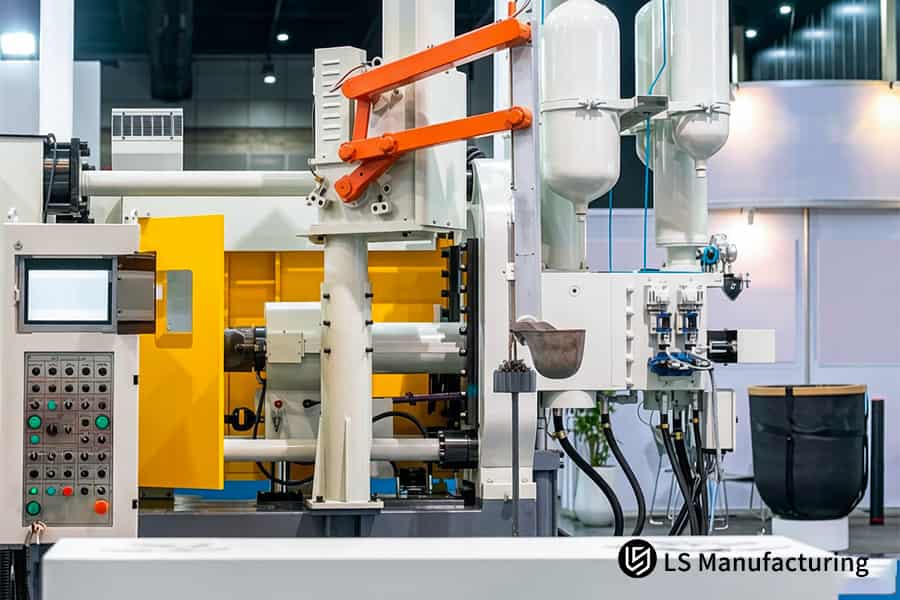
Figure 1: Clamping hardened steel molds prepares the injection chamber for high pressure zinc casting.
How Do Core Tooling Design Variables Drive Long-Term High Pressure Die Casting Cost Efficiency?
By considering only initial mold quotes, procurement managers ignore the concealed costs of high downtime associated with thermal fatigue cracks. The core tooling design variables such as the steel used, its hardness and cooling channel geometry determine the long-term die casting cost factors. Upgrading to H13 steel at HRC 48–52 with conformal cooling eliminates the causes of thermal fatigue which lowers the die casting mold cost.
| Design Variable | Standard Approach | Optimized Approach (H13 + Conformal Cooling) |
| Steel grade & hardness | H13 at HRC 44–48, less hot hardness | H13 at HRC 48–52, more thermal fatigue resistant |
| Cooling channel type | Straight drilled lines, non-uniform heat removal | Conformal cooling channels along cavity shape |
| Thermal cycle time | Baseline (100%) | Reduced by 25%, faster cycle per shot |
| Die fatigue life | Approximately 80,000 shots (average industrial per NADCA) | More than 200,000 shots, 2.5 times higher |
| Per-part tooling cost | Higher due to repairs and replacements | 40% decrease in die casting per part cost |
| Maintenance downtime | ~8 hours/month for crack repair | <2 hours/month, minimal interruption |
The precision die casting manufacturer employing all of these factors guarantees your tooling investments earn the best value. These engineering considerations ensure high pressure die casting cost is economical throughout its total lifespan. No need to worry about costly mold maintenance or downtime; with 2.5x increase in die longevity and 25% higher thermal cycles, you can produce cost-effective custom die casting parts based on NADCA standards.
Which Material Selection Strategy Balances Mechanical Strength And Corrosion Resistance For Automotive Die Castings?
The spectrometer test per furnace maintains Fe below 0.15%, hence avoiding intergranular corrosion. You benefit from 2-3 times greater lifetime compared to standard A380. The custom metal parts manufactur that controls iron content ensures traceability certification. The automotive die casting formula guarantees consistency.
Low-Iron Chemistry Eliminates Intergranular Corrosion Risk
Fe < 0.15% spectrometer analysis per furnace prevents intergranular attack. You have 2 to 3 times more useful life than regular A380. A custom metal parts manufacturer managing iron levels offers certified traceability for this aluminum chemistry.
Proprietary AlSi10MnMg Alloy Balances Ductility and Strength
AlSi10MnMg has a minimum of 10% elongation and 280+ MPa tensile strength, surpassing the 3 to 5% of ADC12. You have a combination of crashworthiness without sacrificing corrosion resistance. An industrial die casting service that documents chemistry per lot fulfills PPAP requirements. You select the right custom die casting alloy to save money and time later.
1,000-Hour Salt Spray Coating Validates Field Performance
Coating passes the 1,000-hour NSS test with a <0.5 mm creepage, making any warranty claims impossible. Addressing the die casting cost factors before the process starts, including coating, reduces total ownership costs by 15-20%. Prototype die casting validation ensures that the coating adheres before the production starts.
Combining low iron content (<0.15%), AlSi10MnMg for ≥10% elongation, and 1,000-hour NSS coating allows you to overcome the strength vs corrosion issue. This spectrometer-proven method sets the engineering standard for e-drive structural parts requiring both mechanical properties and high corrosion resistance.
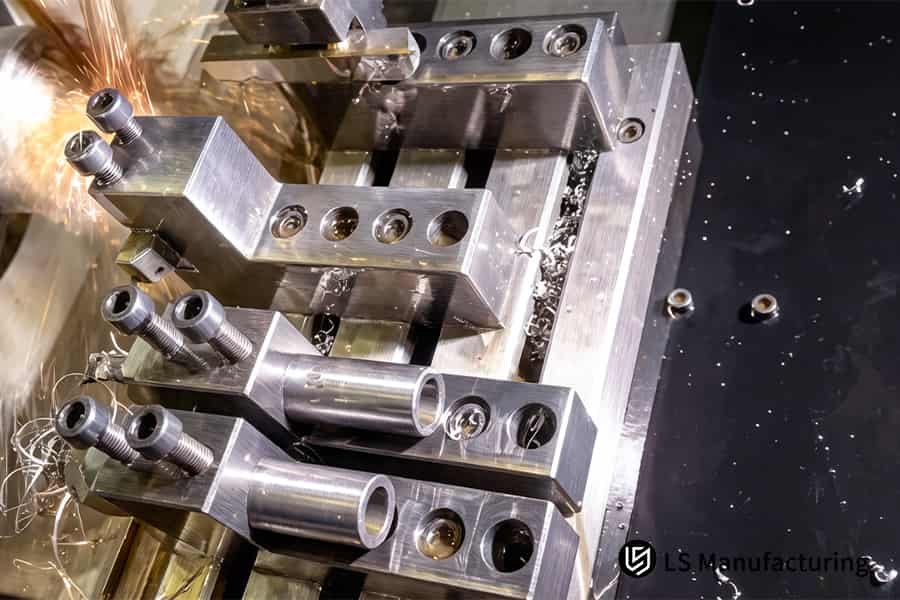
Figure 2: Precision machining center cutting mold cavities generates fine metal shavings for industrial tooling.
How Does Pre-Production DFM Optimization Dramatically Lower The high Pressure Die Casting Cost?
Design engineers who do not consider DFM when releasing drawings frequently encounter problems such as die pull marks for draft angles <1° or stress cracks for wall thickness changes >50%. Pre-production DFM optimization reduces over 90% of the need for secondary CNC operations, lowers costs by 35% per piece and leads times by 35%. A comprehensive die casting cost analysis shows the maximum potential savings prior to making any tool steel cuts. Here's how it helps reduce high pressure die casting cost:
Wall Thickness Gradient Optimization
- Target: Even transition to 1.5–2.5 mm, no more than 50% jump.
- Method: Mold flow simulation determines hot spots before tool steel cutting.
- Your gain: No cracks, no secondary machining, 70% reduction in scrap. One step of die casting DFM already saves a lot of money.
Draft Angle & Slide Geometry Correction
- Minimum draft: ≥1° for vertical walls, depending on alloy shrinkage.
- Slider placement: Relocation of cores prevents manual EDM of undercuts.
- Result: Complete ejection, zero rework. Get a fast die casting quote through DFM and cut 4 to 6 weeks of revision cycle. Die casting lead time reduction will speed up your time to market.
CNC Avoidance via Net-Shape Design
- Secondary ops eliminated: More than 90% of machining and drilling operations after casting eliminated.
- Cycle impact: Manufacturing cycle reduced by 35%.
- Your savings: Unit price reduction scales accordingly. A custom high pressure die casting service with DFM creates assembly-ready components. Dedicated die casting engineering support preserves your design intent while maximizing manufacturability.
With DFM applied within 24 hours of receipt of your 3D CAD file — through optimization of wall slopes, draft angles, and slider positions — you remove 90% of the secondary CNC machining requirement, shorten the cycle time by 35%, and save money on the unit cost. An engineering-led strategy, proven via mold flow analysis and actual manufacturing data, means that DFM is the only tool you need for reducing high pressure die casting cost.
How Does Automated Secondary CNC Post-Processing Maintain Tight Tolerances On High Volume Precision Casting Runs?
When procuring large volumes of precision castings, dimensional drift from inconsistent CNC datum referencing leads to assembly interference and costly rework. Automated secondary post-processing using 5-axis flexible lines, on-machine probe self-leveling, and vision full inspection holds geometric tolerances to ±0.015 mm and achieves Cpk ≥ 1.67 at 100,000 pcs/month. This delivers reliable high volume precision casting output with zero fit issues. Tight die casting process control ensures every part meets specification.
| Process Aspect | Conventional CNC Post-Processing | Automated CNC Post-Processing |
| Datum reference | Machine setup cummulative error | On-machine probe find with a precision die casting manufacturer standard |
| Tolerance capability | ±0.05mm average tolerance | ±0.015mm guaranteed tolerance |
| Inspection method | Method of sampling with CMM | Machine vision inspection which is included in the custom die casting quote |
| Deburring | Manually or separate operation station | Multi-axis robotic deburring inline |
| Dimensional stability (Cpk) | <1.33 (interference problems likely) | ≥1.67 (no assembly fit problems) |
| Production throughput | Depends on manual handling rate | Up to 100,000 pieces per month |
By employing datum probe, vision checking, and inline deburring, you will ensure uniformity in dimensions for your monthly production of 100,000 parts. By attaining a minimum of Cpk value of 1.67 and maintaining tolerances of ±0.015 mm, you save on scrap costs by 60% and on inspection costs by 40%. As a custom metal parts manufacturer, you get your castings completed and ready to be assembled.
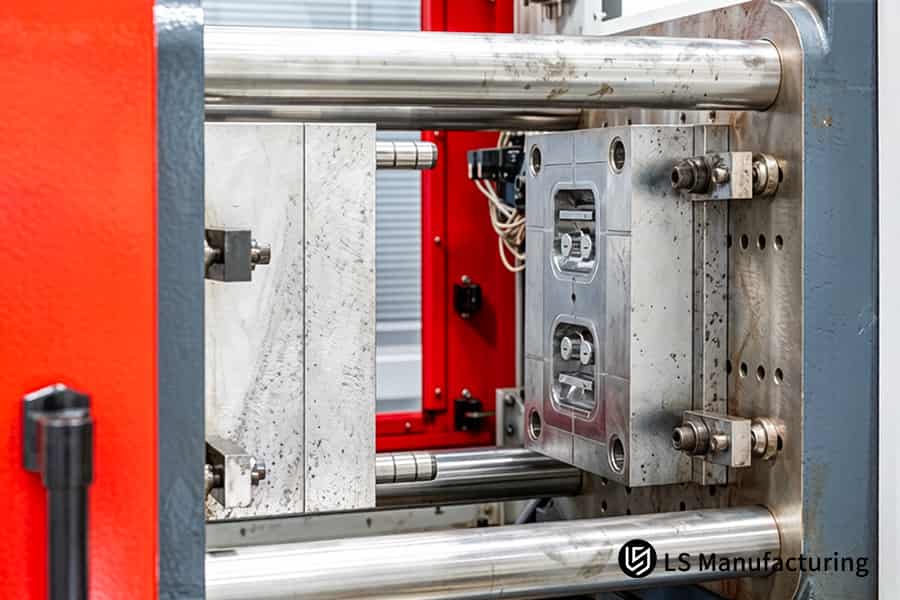
Figure 3: Automated robotic arms extract complex aluminum housings for high volume automotive production.
What Core Requirements Are Needed To Receive An Accurate And Fast Die Casting Quote Within 24 Hours?
Incomplete submission of data from procurement specialists such as lacking information about tolerances, volumes or alloy types prompts suppliers for further details resulting in quotation period lasting several weeks. Complete submission of data (3D STEP/IGES, dimensional 2D drawing, annual volume, surface finish) results in quoting within one day along with DFM comments and mold cost recovery resulting in a fast die casting quote:
Complete 3D & 2D Data Submission
Provide 3D STEP/IGES along with 2D drawing with critical tolerances. It facilitates immediate analysis of geometry and tooling. You will eliminate back-and-forth discussions, reducing response time from weeks to days. Die casting RFQ will be smooth, with prices fixed based on design attributes.
Annual Volume & Surface Finish Specification
Specify the annual volume (for example, 5,000 or 100,000 pcs) and the required finishing (anodizing, powder coating). The volume determines tool amortization while finishing influences cycle time. Get a transparent calculation of the v per unit, where the tooling factor is taken into account. Thus, die casting pricing optimization takes place.
Integrated DFM Feedback Within 24 Hours
The software algorithms and cost engineers assess manufacturability, mold design, and cycle time. The quote contains DFM feedback on draft angles and wall thickness. Get valuable information without spending money on tooling, and avoid change orders. A custom high pressure die casting service based on the rapid assessment produces competitive and risk-adjusted quotes. Request a die casting quote online to streamline the process.
When you provide all of your design information—the 3D/2D drawings, volume, and finish requirements—you trigger the automatic 24-hour quoting engine, which will give you a DFM-based quote with clear mold amortization and cost-per-piece calculations. You will no longer have multiple week-long quoting processes, get an insight into manufacturing risks upfront, and make informed cost comparisons.
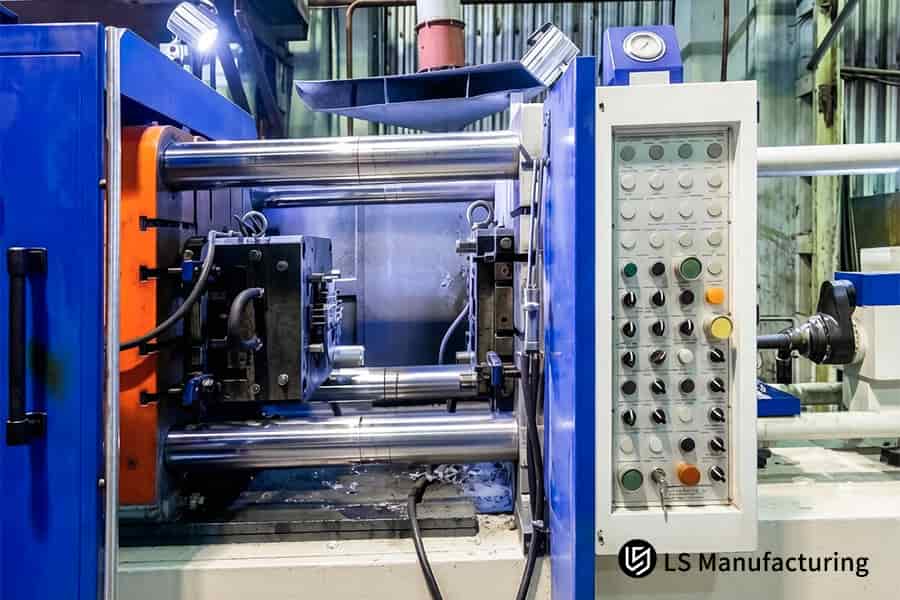
Figure 4: Injecting molten aluminum alloy under high pressure ensures industrial grade precision manufacturing.
LS Manufacturing Custom High Pressure Die Casting Service For Automotive EV Inverter Housings: 45% Weight Reduction And Zero Leakage
Tier-1 automotive supplier was having trouble with their new-generation EV inverter housing: the gravity casting was 8.5 kg per piece, 18% leakage under 0.3 MPa, and the costs were too high. Switching to custom high pressure die casting service fixed all these issues at once:
Client Challenge
The initial design for the gravity-poured A356 casting had walls which were uniformly 4.0 mm thick resulting in excess weight and poor density. At 0.3 MPa, 18% leaked more than 0.5 cm³/min requiring 100% helium testing. This resulted in delay in ramp-up by five months and an increase in landed cost by 62%. The need for the die casting process optimization was imperative to achieve weight, leak requirements and costs.
LS Manufacturing Solution
The casting process was switched to a 1,600-ton machine using vacuum assistance (≤30 mbar). The material was changed to AlSi9Cu3, and wall thickness was adjusted from 4.0 mm to 2.0 mm. There were twelve equally-spaced runner vents used for degassing. In the third test run, the initial venting positions caused porosity in the thin ribs; repositioning two vents and adding an 0.3 mm overflow well solved the problem. This industrial die casting service provided leak-proof and solid castings right away.
Results and Value
The weight was reduced from 8.5 kg to 4.67 kg – a reduction of 45%. The leak test rate is 99.9% for less than 0.1 cm³/min, thus getting rid of the helium test. The cycle time went from 180 s to 42 s, and cost per part was reduced by 52%. Pore-free microstructure passed 3,000-hour thermal cycle vibration test, thereby ruling out fatigue failure. This high volume precision casting enabled them to shorten their schedule by four months. The custom-made die casting guaranteed consistent quality on a mass scale.
Through the use of vacuum-assisted high pressure die casting in place of gravity casting process, optimal wall thickness from 4.0 mm to 2.0 mm and balanced runner vents of twelve numbers, the housing got a 45% weight reduction, 99.9% leak-free rate, and 52% reduction in cost.
Still struggling with excess weight, leak failures, or high costs on your EV inverter housing? Switch to vacuum-assisted high-pressure die casting — 45% lighter, 99.9% leak-free, 52% cost reduction.

FAQs
1. What dimensional tolerances can LS Manufacturing maintain for custom high pressure die casting?
LS Manufacturing reliably meets standard linear tolerance of ±0.1 mm for normal features throughout the entire casting, while managing to maintain ±0.015 mm linear tolerances on critical sealing or mating surfaces using additional CNC machining done internally, followed by CMM inspection of all dimensions.
2. How does LS Manufacturing control porosity in critical structural castings?
LS Manufacturing ensures the porosity level in critical structural castings through the use of high vacuum assisted die casting systems capable of maintaining chamber pressure <30 mbar along with real time PQ² curves for dynamic adjustment of injection conditions, resulting in porosity <0.5%.
3. What is the minimum wall thickness LS Manufacturing can achieve in aluminum die casting?
The capability of high-pressure injection makes it possible to manufacture strong and thin-walled constructional parts with the wall thickness from 1.0 mm to 1.5 mm without the formation of any flows by means of effective gate placement and temperature management of molten metal and die.
4. How do production volumes impact the amortized die casting cost at LS Manufacturing?
Tooling is an upfront cost. As the annual volume of production increases from 3,000 to over 50,000 units, the per part tooling cost decreases by up to 85%, making the higher volumes very cost-effective, not to mention that the costs associated with the raw material and processing per unit are lower.
5. What alloy materials are available for custom high pressure die casting?
We cast various types of alloys for our custom high-pressure die casting, which includes the aluminum alloy (A380, ADC12, AlSi10MnMg) to enhance the strength and thermal conductivity of the material, the zinc alloy (Zamak 3, Zamak 5) with intricate thin walls, and magnesium alloy (AZ91D).
6. What surface finishing options does LS Manufacturing offer for die cast components?
LS Manufacturing offers a wide range of post-processing services that include shot peening for a consistent matte finish, CNC machining for net-shape finishing, electrocoating for corrosion resistance, powder coating for durability, anodizing for wear resistance, and chromate conversion coating for improved adhesion and conductivity.
7. How fast can I receive a formal die casting DFM report and price quotation?
When you provide us with your 3D CAD file (STEP/IGES), as well as the volume of orders for each year, we offer you a comprehensive DFM evaluation pointing out possible problems of the draft, walls, and parting lines, as well as our competitive price list within 24 hours.
8. Why choose LS Manufacturing as your precision die casting manufacturer over local vendors?
LS Manufacturing provides a combination of quality control certified under ISO 9001/IATF 16949, as well as the state-of-the-art vacuum die casting process that allows us to save 40% of costs and guarantee 100% on-time delivery because of our production tracking and project management.
Summary
With our HPDC process utilizing vacuum degassing and conformal cooling technology, we get both lightweighting and structural integration with tight tolerances and porosity-free products. With years of experience, IATF 16949 certification, 1,600-ton die casting and 5-axis CNC technologies, LS Manufacturing offers efficient and economical custom metal solutions from DFM stage to mass production.
Having issues with porosity, low mold lifetime or too costly parts? Upload your 3D CAD (STEP/IGES) files and specifications. Click "Get Free DFM Assessment & Quote" to receive a detailed offer within 24 hours, including flow simulation, cost estimation and mold lifetime warranty—guaranteed saving of over 30%.
📞Tel: +86 185 6675 9667
📧Email: info@lsrpf.com
🌐Website:https://lsrpf.com/
Disclaimer
The contents of this page are for informational purposes only.LS Manufacturing servicesThere are no representations or warranties, express or implied, as to the accuracy, completeness or validity of the information. It should not be inferred that a third-party supplier or manufacturer will provide performance parameters, geometric tolerances, specific design characteristics, material quality and type or workmanship through the LS Manufacturing network. It's the buyer's responsibility.Require partsquotation Identify specific requirements for these sections.Please contact us for more information.
LS Manufacturing Team
LS Manufacturing is an industry-leading company. Focus on custom manufacturing solutions. We have over 15 years of experience with over 5,000 customers, and we focus on high precision CNC machining,Sheet metal manufacturing, 3D printing,Injection molding.Metal stamping,and other one-stop manufacturing services.
Our factory is equipped with over 100 state-of-the-art 5-axis machining centers, ISO 9001:2015 certified. We provide fast, efficient and high-quality manufacturing solutions to customers in more than 150 countries around the world. Whether it is small volume production or large-scale customization, we can meet your needs with the fastest delivery within 24 hours. choose LS Manufacturing. This means selection efficiency, quality and professionalism.
To learn more, visit our website:www.lsrpf.com