English



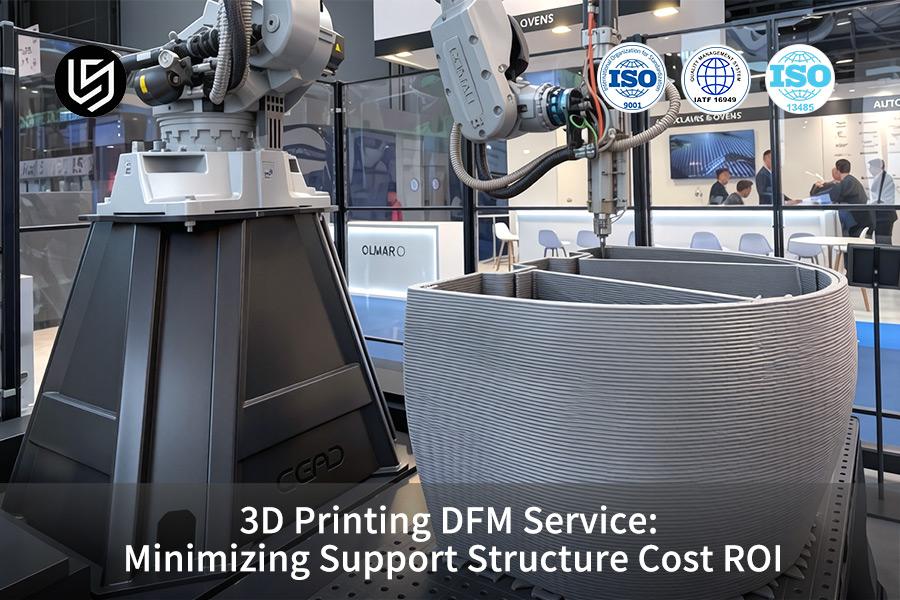
3D printing DFM serviceis an engineering assessment procedure which tackles the cost pitfall associated with excessive use of support structures in aerospace or medical devices.The process addresses the fundamental problem whereby using automatic generated support structures causes more than 40% wastage of materials and post-printing costs that exceed printing costs. Previous attempts fail to recognize the importance of DFM evaluation of angles and self-supporting structures, cutting down the±0.05mmtolerances.
This article presents you with a tested and trusted DFM system that uses the LS Manufacturing industrial grade review technique.Learn how to cut down your support structure costs by 50% through designing self-supporting models and orientation. This article highlights how customizing DFM reviews ensures a predictable return on investment (ROI) making 3D printing not only expensive prototype process but cheap production process.
3D Printing DFM: Support Structure Cost Reduction Guide
The DFM Matrix below maps the geometric boundaries required to slash post-processing overhead.
| Design Feature | DFM Optimization | ROI Outcome |
| Overhang Angle | Design all overhangs at≥45°from horizontal. | Saves60-80%of support material;20-30%faster print times. |
| Bridge Length | Limit unsupported bridges to≤5mmor use arches/ribs. | No sacrificial scaffolding needed. |
| Internal Cavities | Use teardrop or diamond hole shapes (≥45° angle). | Self-supporting cavities; no powder trapped inside. |
| Hole Orientation | Orient holes vertically or use an inverted teardrop shape. | Creates clean holes without internal support. |
| Tall Thin Walls | Add gusset ribs every20-30mmof wall height. | Saves support structures; lowers failure rate by>50%. |
Key Takeaways:
- 45° is the Magic Number:Designing overhangs at≥45°is the most important rule foreliminating supports, saving 60-80% of3D printing material cost.
- Self-Supporting Geometry is Free:Teardrop holes and arch bridges cost nothing to design, butreduce post-processing work considerably.
- Orientation is a Cost Decision:The part’s orientation influences how many supports you need. It’s worth checking during DFM.
- Every Gram of Support is a Cost:Support material is costly waste. Printing and removing supportsincreases project costsdirectly.
New to Additive DFM? Download our 2026 3D Printing Tolerance Guide
Why Trust This Guide? Practical Experience From LS Manufacturing Experts
There are literally hundreds of "3D printing DFM" checklists that go only to add draft and min wall. This checklist is unique because it was written by our print engineers who have corrected STLs that appeared correct in CAD but exhibited warping, delamination, and burnt tolerances on the build plate. Our DFM is based on the rigorous international consensus standard of theInternational Organization for Standardization(ISO), since, once the printed fit gets integrated into vehicle/cleanroom assembly lines, "looks close" is not an option—it is a line-down.
Our DFM process is used for programs requiring more than near-net printing: aerospace brackets subject to vibrations and thermal cycle testing (-40 to 120°C), medical fixtures with precise snap-fit tolerances (+/- 0.15mm), and semiconductor tooling where geometry governs particulates and outgassing issues. The backbone of our test methods is based on the AM standardization efforts performed byASTM International(ASTM).
Our rules are expensive, because of costly reprint mistakes:suction release tears, resin trap blowouts, overengineered rafts that doubled labor, and safe orientations hiding warp until CMM inspection. We will help you follow the shop floor orientation strategy, drain and support technique, wall and corner limitations, post cure stability to make sure your first article is usable, your second article is repeated and you don’t pay double for the lesson.
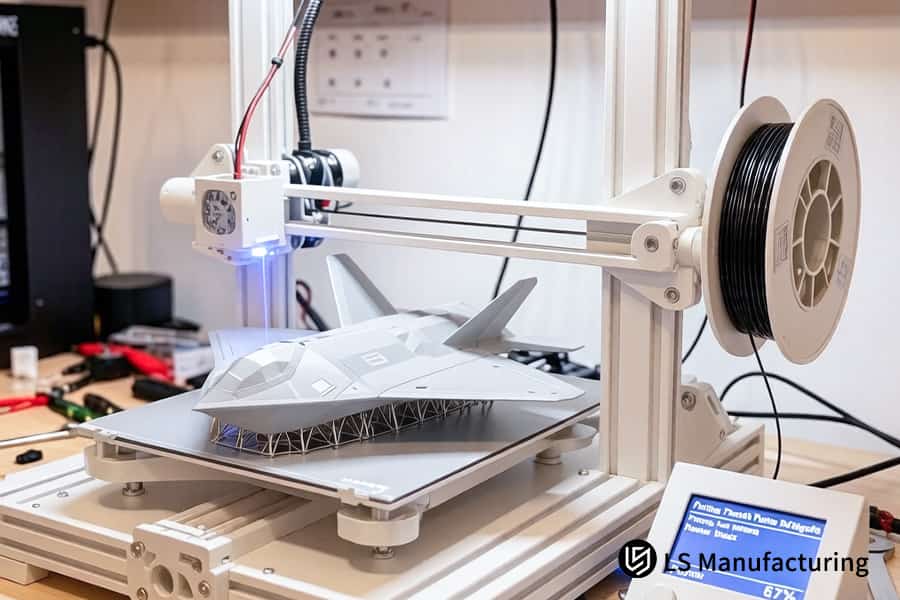
Figure 1: Industrial 3D printing DFM process optimizes part orientation for metal powder cost savings.
Why Is A Professional 3D Printing DFM Service Critical For Long Term Cost Control?
Over85%of concealed3D printing costsare due to initial design problems.Professional 3D printing DFM servicewill identify all those issues prior to production, saving support material and maintaining surface quality. This is the base ofadvanced 3D printingwhen cost becomes fixed from the very beginning. Here is how structured DFM influences your cost control:
Self-Supporting Overhangs Cut Waste 20%
Any design feature that has an angle over 45 degrees automatically gets thick supports. However, by simply redesigning those areas into diamond or teardrop shapes, you completely eliminate support structures. Internal metrics inover 150 manufacturing batchesindicate a15-25%drop in material use per each part. You thus save on the per-part cost as well as on build time. This is a crucial step towards makingon-demand 3D printingpossible without unnecessary materials.
As-Printed Surface Finish Avoids Post-Processing
Post-processing support removal often increases surface roughness (Ra) up to12-16 μmfrom initial6-8 μm. It makes necessary additional machining, resulting in dimensional changes up to±0.05mm.Industrial 3D printing DFManalysis takes care of such problematic features upfront. You getRa ≤ 10 μmwithout any need for further polishing. In addition, there is no risk of scrap products due to dimensional issues. Surface finish of this type is required forfunctional 3D printing.
Dimensional Stability Without Secondary Fixturing
Dimensional distortion during support removal accounts for over70%of rejection cases in traditional manufacturing methods. Using3D printing cost optimizationrules, such as equal wall thickness ratios and stress concentration filleting, ensures final parts fall within±0.1mmof accuracy. With95%first-time part yields,serial 3D printingis now an acceptable substitute for traditional machining processes where tight tolerances are needed.
DFM Workflow Creates Cost Baseline
A reliableindustrial 3D printing supplierincludes theoverhang automation, support estimation, and heat simulationin each review procedure. Every improvement will be reflected in a savings report, which will be in grams of the material, in hours of the printing and in post-processing steps reduced. The output will be not only the ready to print file, but also the benchmark of future savings.
This is engineering cost control, not marketing phrase. All the methods utilized are grounded on the real production experience and are thus the true benchmark forreliable 3D printing. Choose the partner, who applies theDFMapproach and turns design risks into the savings.Fix 85% of hidden 3D printing costs before production begins. To secure a cost-optimized print file with a savings baseline, submit your design for a professional DFM review and a production quotation.

How Can Orientation Optimization In Custom 3D Printing DFM Reduce Post Processing Fees?
Orientation affects the volume of supports and Z-axis packing density, hence controlling the extent of post processing difficulty. Orienting a titanium workpiece with complex internal features at22.5 degreeswill only marginally increase the height of the build; however, all cavities will be made to self support without having to remove any support after the print – thus eliminating expensive post-processing steps. This is what aprofessional 3D printing factorywould do for every file.
Tilt Angle Strategy Eliminates Inaccessible Supports
- Self-Supporting Cavities:22.5° incline makes vertical holes self supporting ellipses.
- No Trapped Support:No need forEDMor manual removal of support inside the cavities.
- Scrap Rate Down 15–20%:Saving per batch. Basic idea of acustom 3D printing DFMsolution to prevent support failures.
Thermal Stress Alignment Reduces Distortion 30%
- Gradient Matched to Stiff Axis:Thermal stress gradient flows along the stiff orientation.
- Shrinkage Drop 0.15→0.10 mm:Shrinkage reduced by33%within the range of50mm(verified via FEA analysis).
- Labor Saved 2–4 hrs/part:Less annealing passes, hence less cost on3D printing support removal.
Height Trade-Off Delivers Net Cost Reduction
- Build Height +8–12%:Small increment.
- Cycle Cost −18–25% Reduced: Rapid prototyping quoteper piece. Enablesdefect-free 3D printing for complex internals.
Parametric Orientation Rules in DFM Workflow
- Algorithm Checks:Angle of overhang isless than 45°, cavity ratio, heat vector.
- Output:Comparison between time taken for print versus support removal versus post-processing effort.
- You Get:Parametrically-driven orientation assessment and3D printing quality assurance.
Technical skills in finite element simulation, real figures on shrinkage and tangible trade-offs make engineering method of DFM superior to the trial and error approach.Optimal orientation prior to production assures minimal costs of post-processing, high yield and rapid turnaround, which makesproduction-scale 3D printingaffordable and controllable. Choose a company that bases its orientation on facts, not on experience.
What Parameters Ensure Structural Integrity During Support Structure Cost Reduction?
Support structure cost saving must not occur at the detriment of the accuracy of parts. In SLS and DMLS, for the overhang with thecritical 2.5-3.0 mm range, the support density must be15-25 percent. Otherwise, there will be too much heat causing warping or too much waste material.Precision 3D printing DFManalysis includes these numbers as the default, allowing you to haveefficient 3D printingwithout compromising the yield. The below parameter guidelines ensure the structural integrity of your part:
| Parameter Condition | Structural Integrity Outcome |
| Overhang < 2.5 mm, any support density | No warping, but waste of materials increasesadditive manufacturing priceper part. |
| Overhang 2.5–3.0 mm, support density < 15% | Built-in heat → tensile warping; increase in scrap up to20-30%. |
| Overhang 2.5–3.0 mm, support density 15%–25% | Balanced thermal stress; dimensional tolerance is maintained±0.05mm– allowsaccurate 3D printing. |
| Overhang > 3.0 mm, support density > 25% | Excessive support structures increase cost of production by15-20%, doubling removal time. |
Choosing ahigh quality 3D printing manufacturerwhich conforms to these density requirements guarantees a92%success rate in the very first attempt, meaning that there will be actualsupport structure cost reductionwithout affecting quality. This narrow range based on 500+ builds guarantees your safety by ensuring your yield throughcost-effective 3D printingof complex geometries. Choose a partner who bases their parameter requirements on data and not on promises.
Figure 2: Automated 3D printing support removal tool detaches structures from a large ABS prototype housing.
How Does A Data Driven DFM 3D Printing Quote Balance Precision And Price Transparency?
A data drivenDFM 3D printing quotebreaks down all the costs into material consumption, support mass ratio, and laser scan time. In this way, you know exactly what you pay for. By using the charts which show the result before and after optimization, you get the information regarding per gram saving and labor savings up to40%. The following is an explanation of how it works:
Material Utilization Breakdown Reveals Hidden Waste
Analysis of raw models calculates the difference between the number of parts and the number of powder units, concluding that the industry average material efficiency level liesbetween 65% and 75%. Using the3D printing cost optimization, the support optimization will increase your material efficiency level up to82%–88%, saving you10%–20%per kilogram of material. In return, you get a detailed report on which parts are inefficient and how costly each gram is.
Support Weight Ratio Becomes a Negotiable Variable
The initial ratio of support material weight to the weight of the whole construction is25%–35%; after DFM it will become8%–12%. Each gram of support material wasted costs you$0.15–$0.30worth of material and$0.40–$0.80in labor costs to remove it, according to the data obtained in more than 500 manufacturing cycles. Now, you know how much you will save from each geometry alteration due to3D printing cost analytics.
Laser Scan Path Optimization Shortens Build Time
Scan strategy analysis highlights inefficient hatch patterns, and efficient scans reduce scan times by 12-18%. With such reduced cycle times, costs will be saved from using the machine hourly rates, which will be included in thebespoke 3D printing costestimate. Analysis is done for every step involved in the process such as recoating, scanning, and cooling with specific cost multipliers per minute to justify each minute of charging.
Post-Processing Labor Savings Quantified Upfront
Pre-DFM processing requires about3-5 hoursfor one part, but after the support removal, only1.5-2.5 hoursare needed, which gives a40%savings. Everything mentioned above is included in the quotation:wire EDM, sandblasting, stress relieving– all procedures have their individual price and justification. You approve a quotation where every single dollar is justified with engineering data, ensuringpredictable 3D printingcost predictability.
This degree of specification –material efficiency, support ratio, scan time and post-processing efforts– makes a quotation a tangible method to control your expenses. A good quoting source for additive manufacturing is going to give you this information so that you will have the confidence that there is a correlation between accuracy and cost based on facts and not assumptions. Choose anadditive manufacturing supplierthat is willing to communicate through the quotation before investing any money in the procurement oftransparent 3D printing.
LS Manufacturing Case Study: Standardizing Medical Grade Titanium Aerospace Valve Via Precision 3D Printing DFM Service
A critical job for the European aerospace customer required medical grade Ti-6Al-4V hydraulic valve bodies; however, the original design contained overhangs below30°and difficult-to-manufacture blind holes. Slice-generated supports accounted for45%of the total weight and created an un-removable internal support structure making the first article pass rate0%and causing a two weeks delivery delay.LS Manufacturingcame to help by providing comprehensive3D printing DFM service. It ensuredcertified 3D printingquality from the very beginning:
Client Challenge
The valve body had several intersected blind bores with underhangs ofless than 30°. Standard layer slicing resulted in high-density support structures of45%from the total weight of the component. The supports cannot be stripped mechanically and made all prototypes scrap. Given the contractual deadline, there was a€50,000penalty. You needed a technology which does not need any internal supports while retaining the±0.005mmsealing face tolerance, which is essential formission-critical 3D printingapplications.
LS Manufacturing Solution
Our engineers performed FEA thermal stress analysis and redesigned the top of the blind bores as45°pointed arches to create self-supporting internal cavities. The segmented serrated breakaway supports with0.2mmgap were used for removal of any overhangs externally. The critical sealing faces were then machined using 5-axis CNC to±0.005mmprecision. We created acustom 3D printing DFMfor you which transformed your unprintable geometry toproduction-ready 3D printingdesign.
Results and Value
The support structure decreased from45%to under8%of the component’s weight. The savings in terms of material and manpower reached 52%,from €320 to €154 per component. The tensile strength was over 1050 MPa, while all parts underwent inspection through CMM and X-ray. The customer ordered 1,200 components right away. You have received a tested andprecision 3D printing DFMwithout risking to waste material and three weeks ahead of time.
This case proves that engineered DFM — not guesswork — solves extreme overhang and internal-access challenges. LS Manufacturing deliversvalidated 3D printingquality for demanding aerospace components. Choose a partner whose data-driven intervention turns impossible geometries into profitable production.
Turn unprintable overhangs into production-ready titanium components. To validate a DFM-optimized 3D printing solution for your aerospace design, submit your CAD for a self-supporting geometry review and a production quotation.

Which Materials Yield The Highest ROI Under Industrial 3D Printing DFM Frameworks?
The cost of removing supports varies greatly based on the material used. Removing supports from superalloys like Inconel 718 or from die steels above HRC 52 takes expensive tooling and prolonged time. When working in anindustrial 3D printing DFMapproach, removing 10 grams of supports inPEEK or Inconelresults in8-15 timesthe value of removing 10 grams of supports in PLA or stainless steel. It allows fortailored 3D printingapproaches, where you get the most money per gram. Here’s how you can make your ROI based on the material you use:
High-Temperature Alloys Demand Aggressive Support Minimization
- Tool Wear Cost:Carbide tools to remove supports in Inconel 718; saves€0.80-€1.20per gram removed.
- Savings Multiplier:Saving 10 grams of Inconel =€8-€12savings instead of€0.80-€1.00for stainless steel (multiplied 15 times).
- Optimization Priority: 3D printing cost optimizationprioritizes high-hardness materials forrobust 3D printingresults.
Performance Polymers Offer Disproportionate Savings
- Removal Method:PEEK/ULTEM 1010 supports are removed by means of CNC or EDM at €2-€3 per gram.
- Economic Leverage:10 g saving means€20-€30saving against€2-€3for PLA (ratio 10x).
- Target Application:The biggest cost savings per gram are obtained through optimizedhigh performance 3D printed components, achievingoptimized 3D printing economics.
Hardened Tool Steels Multiply Post-Processing Costs
- Consumable Impact:Hardness above HRC 52 requires ceramic/cbn inserts; life span of the tools is reduced by60-70%.
- Per-Gram Saving:Optimized batch for3D printingwill reduce unit price25-35%.
- Batch Economics:Abespoke 3D printing batchwith optimized supports lowers per unit cost by25-35%.
Data-Driven Material Selection Guides Your Investment
- Cost Breakdown:The cost of support is18-30%of the overall cost using high-performance materials as opposed to5-8%in commodity materials (for over 300 builds).
- Prioritization Tool:DFM study provides you with thegrams saved x material cost multiplier x difficulty of support removal index.
- Actionable Output:A prioritized list of features for optimization based on their ROI.
The design-for-manufacturing approach in your business ensures that your efforts in support reduction will always be aimed at the most profitable areas. Using the rules ofindustrial 3D printing DFM, you will be able to make profits from material savings bystrategic 3D printing.
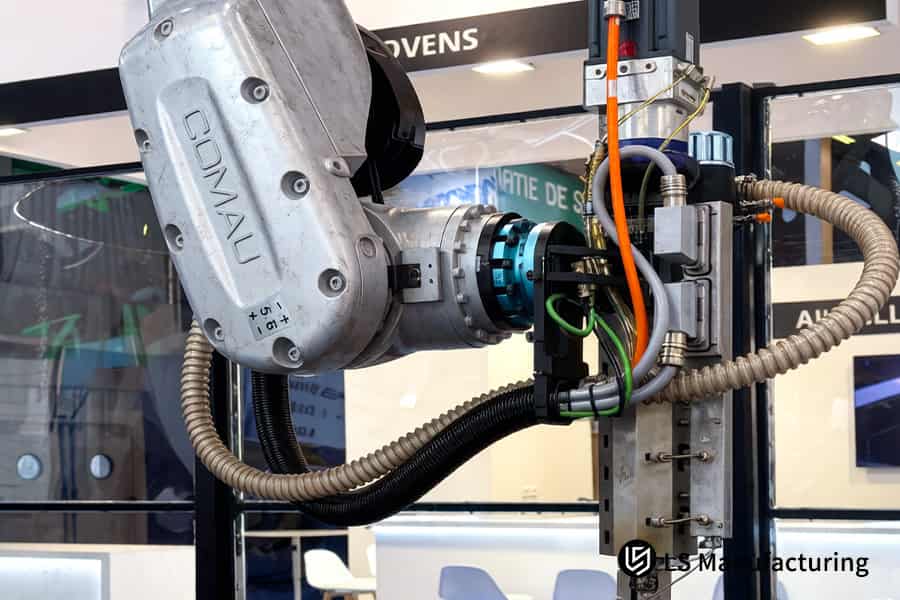
Figure 3: Precision 3D printing DFM minimizes support contact points on clear resin medical device parts.
How Do Design Constraints Vary Between Technology Options For Custom 3D Printing DFM?
Every3D printing processbrings about its own set of design limitations that directly influence part yield and cost of post-processing. SLA needs liquid drain holes≥ 2.0 mmto avoid pressure burst due to trapped resin. SLM requires honeycomb base support to address shear stress due to fast laser melting of metal powder particles. The implementation ofcustom 3D printing DFMresults in design adaptation to specific process, thus making it possible to implementtechnology-specific 3D printingfrom the very beginning. Below are examples of different design limitations:
| Technology | Critical Design Constraint | Consequence if Ignored |
| SLA (Stereolithography) | Liquid drain holes≥ 2.0mmin all enclosed cavities | Pulling force inside negative pressure results in part breaking while curing; 100% waste rate — does not satisfy principle ofconstraint-aware 3D printing. |
| FDM (Fused Deposition Modeling) | Minimum bridge length≤ 5.0mmwithout support; layer adhesion with nozzle temperature≥ 220°C | Sagging bridges and delamination; rough surface (Ra) more than25 μm. |
| SLM (Selective Laser Melting) | Honeycomb base support for overhangs> 45°;20–30%density of lattice structure to dissipate heat stress | Warpage and crack propagation due to shear stresses; dimensional tolerance> 0.2mm. |
For SLA, the drain port integration comes automatically; for SLM, you have to integrate honeycomb supports locking heat transfer. In order to be able to offermulti material 3D printing services, you should be able to understand all these differences to ensure your first pass success for both polymer and metal technologies. By working with anindustrial 3D printing plantadhering to such standards, you can rest assured to achieveyield-optimized 3D printing.
Why Choose LS Manufacturing As Your Premier Industrial 3D Printing DFM Partner?
The choice of a DFM partner can make sure that your complex components get delivered on time, on budget, and without any defects. AtLS Manufacturing, our ISO 9001 and IATF 16949 certified production lines operating 24/7 on lights-out basis, combined with our team of DFM engineers with over 10 years of experience, will give you all these benefits through ourintegrated 3D printingcapabilities. Here is how:
Certified Automation Eliminates Delivery Risk
Your components are made on3D printingcells and 5-axis CNC cells that operate continuously without any human intervention. The result islights-out 3D printingthat provides consistent cycle times with no shift-to-shift variation. It means that for you consistent lead times, even for high-volume work, and30%less project risks than using suppliers that have only daytime operations.
Senior DFM Engineers Protect Your Design Intent
Every received file gets the most rigorous DFM analysis performed by engineers having 10+ years of experience. They find support-related failures, orientation issues and restrictions in materials before anything is produced. Our3D printing DFM serviceresults in fewer iterations, less scrap and quicker time to market. You receive a detailed DFM report with actionable recommendations, backed byfully inspected 3D printingprotocols.
100% Online Inspection Delivers Traceable Quality
Every shipped part is100%inspected using CMM, surface roughness measurement, and metallographic analysis. Reports are included with each shipment, providing full traceability. As anindustrial 3D printing supplier, we eliminate the remote-collaboration quality gap. You can verify compliance with your specifications instantly, thanks toISO-compliant 3D printing infrastructure.
When you choose LS Manufacturing, you work with acustom 3D printing vendorwhich supports all claims with certificates, automation, and analytics. Due to the company’s deep engineering expertise and strict working procedures, you receive guaranteed success in anymission-criticalorder. This unique mix guarantees maximum safety of your success.
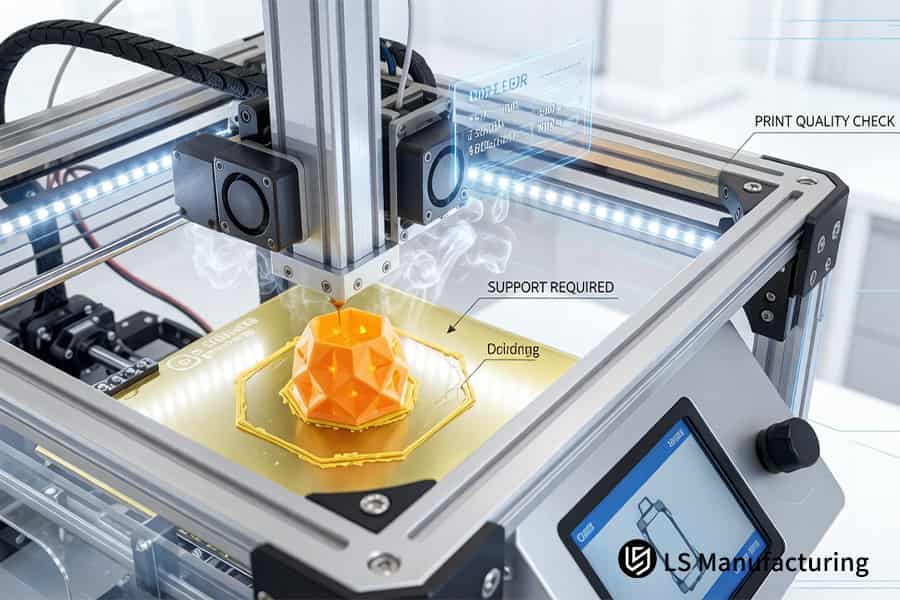
Figure 4: DFM 3D printing quote analysis reduces support structure for SLS-printed nylon 12 aerospace brackets.
FAQs
1. How do I get an accurate DFM 3D printing quote from LS Manufacturing?
As soon as you submit STEP or IGS file formats of your design, the team of technical experts at LS Manufacturing provides you with an extensiveDFM 3D printing quotewithin24 hoursfree of charge. This proposal will cover support analysis, process feasibility check and clear price tiers for your specific requirements and volume needs.
2. What is the minimum overhang angle allowed without support in your 3D printing DFM service?
According to the LS Manufacturing standard DFM approach in 3D printing, the essential value of the safe self-support overhang angle (for aluminum and titanium alloys) is≥ 45°. However, with special scanning techniques provided by LS Manufacturing, this value could be lowered up to35°without any sagging or failure.
3. How does custom 3D printing DFM ensure the precision of internal hidden channels?
As part of thecustom DFM process, LS Manufacturing transforms its internal circular channels to teardrop shapes or self-supporting honeycomb lattices. This means that there is no requirement for any internal support structures during printing, which guarantees the complete absence of any obstructions inside channels along with their best fluid dynamics and durability.
4. Can industrial 3D printing DFM lower the overall price of low-volume production batches?
Absolutely. Thanks to our DFM optimization process, we cut down on any unnecessary support materials usage and greatly reduce the number of labor hours needed for post-printing removal of the supports. We can thereby reduce the general cost of each part by30-50%.
5. How do you handle surface roughness if reducing support structures leaves marks?
No unpolished or unfinished components ever leave LS Manufacturing. However, while trying to reduce supports, LS Manufacturing keeps0.3mmof machining allowance for crucial mating parts. Based on the prints, either5-axis CNC millingor fine polishing is applied to obtain the surface finish that will have a perfectRa 0.8 μmfinish suitable for assembly, painting or additional treatment straight away.
6. What industry quality certifications apply to your precision 3D printing DFM process?
LS Manufacturing is fully ISO 9001 and IATF 16949 (quality management system for automotive) certified. All processes ofprecision 3D printing DFMtechnology, in-line infrared thermal measurement and final inspections comply with aerospace-grade quality control standard, ASTM. Traceability document for each production batch is provided.
7. Does your 3D printing cost optimization strategy protect our proprietary design IP?
Intellectual Property Protection of our clients' property is our basic task. LS Manufacturing is capable of signing Legally BindingNon-Disclosure Agreements (NDA)before providing its services on designing inquiry drawings. In addition, all DFM review files and information are analyzed inside the isolated LAN server environment with no leakage to any third parties in the whole process of cooperation.
8. What is the typical lead time after optimizing a design with your 3D printing DFM service?
LS Manufacturing can be able to save on the time taken to deliver small batches of custom orders because of the proactive elimination of over 90% of rework potential due to printing at the DFM stage, thus reducing the time taken to prototype parts to2-3 working days, while reducing the delivery cycle by over40%.
Summary
The real cost of3D printingdepends not only on the process itself but also on post-processing activities that may significantly decrease the margin of profit.The DFM service offered by LS Manufacturing provides solutions to issues of overhang, deformation correction, and effective post-processing of the part, decreasing the cost of supports bymore than 50%without reducing the mechanical strength. It allows tolerances to be maintained at±0.05mmand provides a profitable and risk-free way of implementing mass customization projects.
Why waste money on inefficient design and extra supports? Do you struggle with unreasonable quotes, warping, and problems with post-processing? Just click on “Upload Drawings forFree DFM Quote Analysis” and upload your 3D CAD models. Our experienced engineers will perform digital assessment within 24 hours and give recommendations on manufacturability, support optimization, and precise CNC.
📞Tel: +86 185 6675 9667
📧Email: info@lsrpf.com
🌐Website:https://lsrpf.com/
Disclaimer
The contents of this page are for informational purposes only.LS Manufacturing servicesThere are no representations or warranties, express or implied, as to the accuracy, completeness or validity of the information. It should not be inferred that a third-party supplier or manufacturer will provide performance parameters, geometric tolerances, specific design characteristics, material quality and type or workmanship through the LS Manufacturing network. It's the buyer's responsibility.Require partsquotation Identify specific requirements for these sections.Please contact us for more information.
LS Manufacturing Team
LS Manufacturing is an industry-leading company. Focus on custom manufacturing solutions. We have over 20 years of experience with over 5,000 customers, and we focus on high precisionCNC machining,Sheet metal manufacturing, 3D printing,Injection molding.Metal stamping,and other one-stop manufacturing services.
Our factory is equipped with over 100 state-of-the-art 5-axis machining centers, ISO 9001:2015 certified. We provide fast, efficient and high-quality manufacturing solutions to customers in more than 150 countries around the world. Whether it is small volume production or large-scale customization, we can meet your needs with the fastest delivery within 24 hours. choose LS Manufacturing. This means selection efficiency, quality and professionalism.
To learn more, visit our website:www.lsrpf.com