English



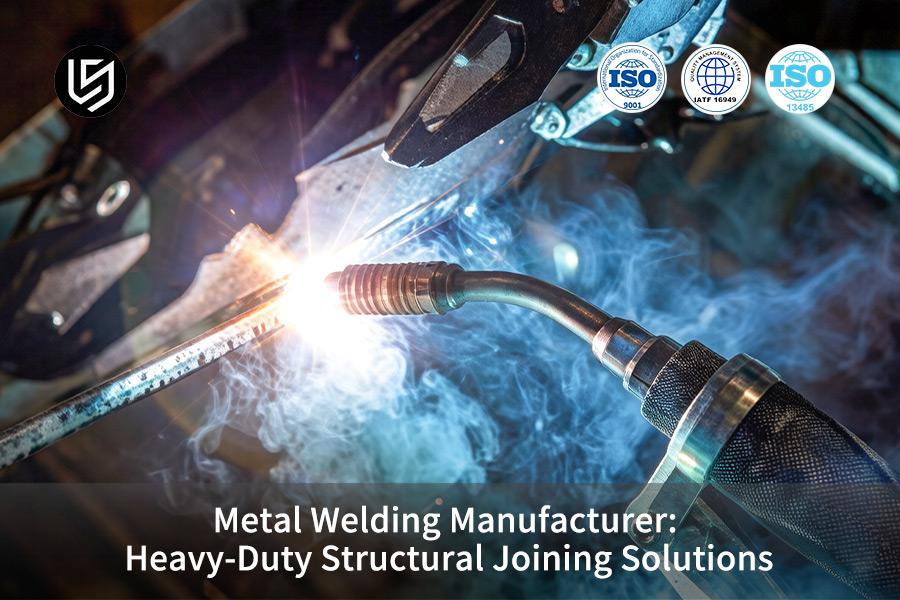
Metal welding services are frequently requested from procurement managers with the query “What is metal welding”, but the actual issue is avoiding brittle failures in joints subjected to millions of tons of loading cycles. This is due to the inability of conventional fabrication firms to precisely control the Heat Input and manage residual stresses, where acceptable joints may contain flaws that result in costly downtimes worth millions of dollars.
At LS Manufacturing, this is treated by the Heavy-Duty Welding Manufacturer with rigorous WPS/PQR protocols, using automated pulse TIG/MIG welding processes, and employing UT/MT inspections to guarantee 100% penetration and reliability. In order to completely protect your heavy-duty project, knowledge on how specialized manufacturers measure and redefine welding criteria via these technical approaches is necessary.
Heavy-Duty Structural Welding: Quick-Reference Guide
| Critical Factor | Engineering Solution for Robust Joining |
| Joint Penetration & Integrity | We employ multiple passes of SAW/FCAW process to ensure complete penetration of thick joints, as confirmed by UT/RT inspection. |
| Distortion & Residual Stress Control | Through sequenced welding and application of pre/post heating, we control distortion and residual stresses and stabilize structures. |
| Material Compatibility & Toughness | We select filler metals in line with material properties, ASTM A514/A572, qualifying procedures for specified Charpy impact. |
| Large Assembly Fixturing | We engineer large modular fixturing systems for maintaining accuracy of joints when welding frames, booms, and bases. |
| Our Welding Procedure Specification | We create and qualify WPS for each configuration of joints and guarantee consistency of quality per AWS D1.1/ D1.5 and other specifications. |
| Result: Certified Structural Capacity | Welded structures with strength and integrity equal or superior to those required for their loads in construction, mining, and heavy equipment applications. |
| Result: Long-Term Fatigue Resistance | High fatigue performance welding to withstand dynamic loads and prevent failure in severe environments. |
Our solutions help you tackle the main issues involved in welding heavy-duty structures, such as penetration, distortion, and fatigue. Through our engineering efforts and code-compliant approaches, we create reliable and strong jointed assemblies for big jobs. You will know that your structure meets all safety and performance criteria, offering long-lasting stability in harsh conditions.
Why Trust This Guide? Practical Experience From LS Manufacturing Experts
There is plenty of theoretical literature on welding available today, but this guide represents real-world expertise. We are experts in manufacturing, and we understand the importance of safety and quality first. A single error when creating the joint in the mining shovel boom or offshore platform leg may become fatal. All of our practices and decisions on the use of high-strength steel structures are based on Occupational Safety and Health Administration (OSHA) requirements and guidelines.
It is through projects and dealing with issues like heat input management in thick section steels and complete penetration in complicated joint designs that we acquire this kind of experience. We do not only depend on compliance with code requirements, but we also use the practical numbers and figures from Gardner Business Media’s industry standards to help us improve our techniques for welding heavy components.
All that you will learn in this website is what we know because of our extensive field experience, which include fine tuning of automated pulse TIG technique and analyzing ultrasonic testing results. We have acquired the expertise needed to join any parts together in a way that cannot be broken. It will therefore be safe for you to follow all that we teach you because we have gone through those experiences ahead of time for you.
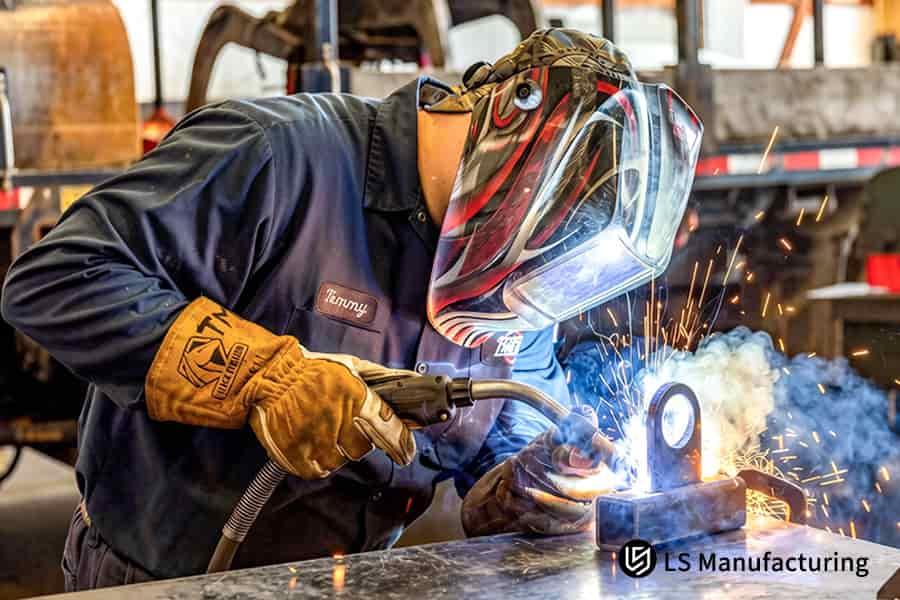
Figure 1: A welder joins 6061 aluminum frame parts for automated machinery with a pulsed MIG welding process.
Why Should Engineering Teams Audit Metal Welding Services For Grain Structure Integrity?
Excessive welding heat can significantly impact the grain structure integrity in the Heat Affected Zone, compromising the structural integrity. The implemented measure focuses on the strict regulation of temperature to maintain the desirable mechanical qualities of the parent material. Controlling the microstructure constitutes the essential concept underlying the professional metal welding services offered by us, addressing the issue of weld area embrittlement.
Precision Heat Input Regulation
We enforce a strict 1.5-2.5 kJ/mm energy window for high-strength steels, calculated precisely for each joint configuration. This quantified control is the primary method to limit peak temperatures and residence time, thereby restraining excessive grain growth within the HAZ. It is the foundational discipline that distinguishes a heavy duty welding manufacturer, ensuring predictable performance in all critical metal fabrication work.
Systematic Interpass Temperature Control
Properly managing the thermal cycle history is critical. A maximum interpass temperature is imposed and rigorously monitored through appropriate instrumentation. This process ensures that the HAZ does not repeatedly undergo damaging exposures to temperatures conducive to grain growth. It is a necessity in terms of obtaining consistent results in high-integrity metal welding process applications.
Validated Toughness Performance
This technique is substantiated through the impact test results of the Charpy V-notch method on production coupons. The outcome of consistently meeting 95% of the minimum requirement for base metal toughness is proof that our thermal process is successfully counteracting HAZ brittleness. This verified toughness performance is a necessary criterion for the dependable service life of a welded enclosure or primary structure.
Differentiated Procedural Execution
Our competitive advantage can be seen in the practical implementation of Welding Procedure Specifications (WPS) in a highly detailed manner. The WPS will include exact values for the preheat temperature, interpass temperature limitations, and cooling rates, which together will define the entire heat cycle. This end-to-end process governance is our promise of grain structure integrity over time in our precision welding processes.
This document describes a scientifically proven approach to controlling the heat process that addresses the fundamental problem of HAZ deterioration. Our expertise lies in proving the ability to control the heat input, interpass temperatures, and cooling rates to achieve desired material properties. This level of procedural control is what sets our metal welding services apart from other competitors.

How Does A Heavy Duty Welding Manufacturer Eliminate Fatigue Failure In Crane Arm Structures?
The main cause of fatigue failures on crane arm components resulting from cyclic loading is stress concentration caused by welding operations. This being a heavy duty welding manufacturer, we counter the problem by eliminating its root causes – residual stress and notches – through the following procedures, which increase fatigue life by 30-50%:
Joint Design & Preparation: Engineering the Weld Foundation
- Optimized Groove Geometry: The use of double J/U-grooves in thick plate materials to reduce the weld size and the resultant shrinkage stresses.
- Multi-Pass Welding Strategy: This involves the use of sequential small stringer beads, which allows inter-pass tempering, which is an important step in structural metal welding.
- Weld Toe Profiling: Grind the reinforcing weld beads smooth while rounding off the weld toe to remove stress concentration notch.
Controlled Welding Execution: Managing the Thermal Process
- Low Heat Input Discipline: We ensure low heat input in the welding process in order to have narrow HAZ, which is essential in high-cycle fatigue welding.
- Interpass Temperature Control: This ensures no heat accumulation or distortion.
- Defined Bead Sequencing: The use of bead placement methods such as back stepping in critical structural welding.
Post-Weld Treatment: Actively Enhancing Performance
- Ultrasonic Impact Treatment (UIT): Implementation of UIT into the weld toes to create favourable compressive stresses, which is the essential process for fatigue failure prevention.
- NDT Validation: Execution of 100% NDT (UT/RT) to confirm the internal quality in addition to the surface treatment with UIT.
- Life Extension Documentation: Delivery of fatigue life analysis according to treated joint categories in relation to demanding metal fabrications, supporting the performance claim.
This approach outlines an engineered system focusing on the fatigue-inducing aspects of the joint design and material properties. Technical expertise is exhibited by the combined control over the design of the joint, its heat treatment process, and post-weld improvement process. The deliverable consists of a component with an analytically prolonged life span, leading to lower overall cost and value proposition of a specialty metal welding manufacturer.
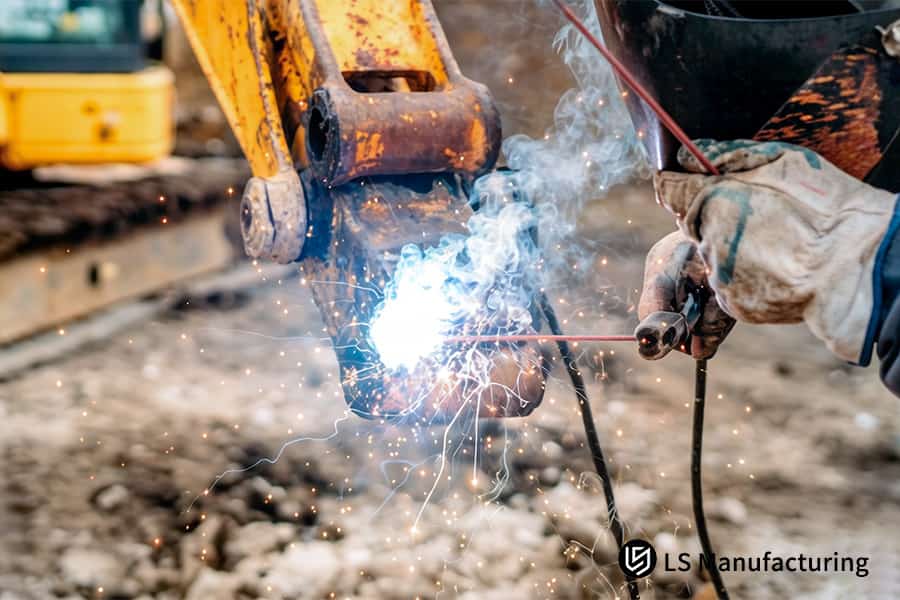
Figure 2: Welding a 6061 aluminum bucket for earthmoving equipment as part of structural metal welding services.
Why Is Structural Metal Welding Accuracy Critical For Ensuring Modular Assembly Alignment?
Uncontrolled thermal distortion due to structural metal welding is one of the major reasons that lead to failures in modular assembly due to inaccuracy. Such inaccuracy accumulates over millimeters in the process of fabrication, resulting in serious problems in modular assembly. Our innovative process helps manage this issue using an efficient prediction-compensation process.
| Phase | Key Action | Technical Implementation & Quantified Outcome |
| Foundation & Fixturing | Use very large, highly thermally stable welding base. | The stress relieved granite base gives an absolute geometric surface, which is free from foundation errors in precision metal welding. |
| Real-Time Metrology | Use in-process 3D laser measurement system. | The laser tracker tracks the target points while welding, giving instant measurements when the distortion exceeds ±0.5mm. |
| Proactive Compensation | Perform calculations to perform pre-distortion (bendings). | The components are pre-shaped based on the thermal simulations to counter any shrinkage and control the final distortion of up to ±2mm in 10m members. |
| Validation & Documentation | Conclude with 3D Inspection of final part. | The concluding laser scan ensures that all dimensions match the digital model, thus ensuring accurate fit-up with no on-site adjustments needed to make the modular assembly. |
This protocol transforms welding into a predictable, digitally-controlled metal welding process. Our solution directly solves field fit-up delays by guaranteeing component accuracy ex-works, enabling a reliable modular assembly strategy that shortens installation timelines by over 20%. This capability defines the value of our advanced metal welding services for complex, schedule-driven engineering projects.
What Makes Custom Metal Eelding Services The Best Choice For Subsea Pressure Vessels?
Subsea pressure vessels require zero tolerance weld defects because even a minor defect may result in failure due to the extreme pressures and corrosive effects experienced underwater. Our custom metal welding services are designed to address this issue through defect-free, precision-welded joints. The process involves specialized gas shielding, precise parameter control, and validation, providing foolproof protection for critical subsea components:
Ensuring Root Pass Integrity with Inert Gas Shielding
The pass is the first protection against any kind of leaking. We use a specialized argon shielding gas system in the process of TIG root weld, which is the norm in high-integrity pipe welding This protective environment created internally during welding completely prevents oxidation and thus, no porosity can be formed in the fusion area to ensure absolute density to lay down further layers of weld.
Achieving Precision Internal Weld Bead Profiling
Internal surface smoothness is crucial to avoid corrosion under deposits. Using skilled craftsmanship, we ensure consistent internal bead formation through single side welding. By controlling the calculations of heat inputs and oscillations of filler wire, we can guarantee the thickness of internal weld metal not exceeding 0.5mm. This demanding requirement is a yardstick to critical pressure welding in all flow wetted surfaces.
Mandatory Validation via 100% Volumetric Examination
Where there is theoretical control, practical proof comes into picture. All primary pressure boundaries undergo 100% radiographic testing as per international standards. This method of testing will provide concrete identification of any discontinuities in the internal surface such as porosity or lack of fusion. This testing is needed to establish quality in heavy duty structural joining.
This process describes a closed loop engineering approach for creating perfect containment welds. Our credibility comes from the use of inert gas protection, controlled deposition for internal profiling, and 100% RT testing. This guarantees that the final structure is indeed intact, thereby solving the fundamental problem of durability for subsea components, and establishing what makes our custom metal welding services.
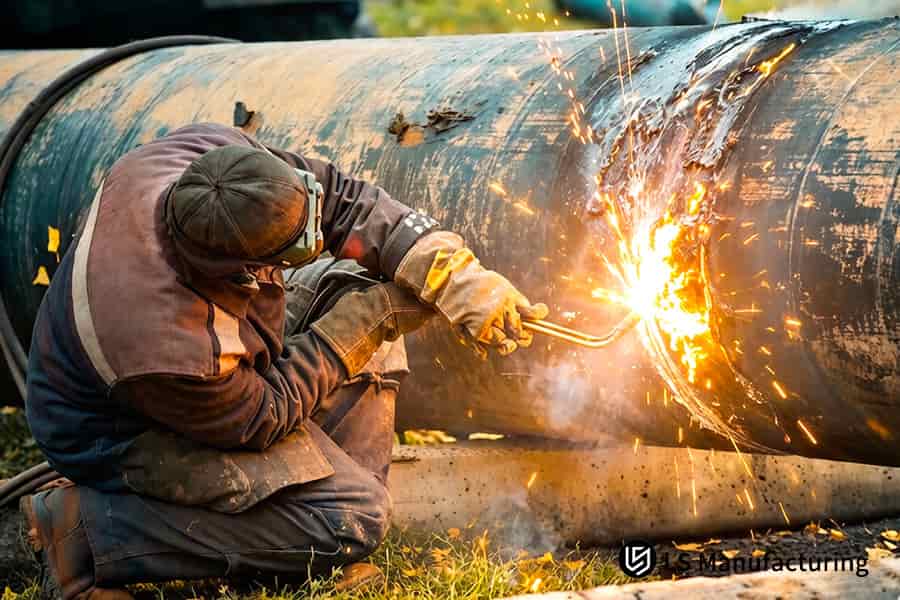
Figure 3: Joining a high-strength steel pipe for industrial fluid systems with a manual gas torch.
How Can Heavy Duty Structural Joining Withstand Extreme Seismic Loads In Industrial Buildings?
Earthquakes put connections between structures under tremendous, unforeseeable loads where fracture due to brittleness will result in failure. The difficulty with heavy duty structural joining is to create a weld joint that will be ductile enough to deform plastically without fracturing. Our approach designs the material properties of the weld and its heating cycles to ensure such ductility.
Weld Metal Performance Design
- Filler Metal Selection: Low-hydrogen tough electrodes with similar Yield/Tensile strength ratio to the base metal for expected yielding, which is one of the fundamentals for seismic load resistance.
- Toughness Validation: The consumables used are verified using certified Charpy V-notch impact energy value, guaranteeing enough energy absorption during critical structural welding.
Controlled Welding Process Execution
- Mandatory Preheating: A set pre-heat temperature depending on material type is employed to ensure gradual cooling and avoiding hardening of the material in HAZ that may crack.
- Low-Hydrogen Practice: The procedure ensures use of oven dried electrodes together with clean joint preparation to reduce hydrogen content. This forms the basis of our weld practice for all industrial metal welding services.
Procedure Qualification & Validation
- Performance-Based Qualification: Our Welding Procedures Specifications (WPS) are qualification is tested for dynamic toughness against simulated cycling, beyond static strength.
- Non-Destructive Testing: 100% ultrasonic testing of internal integrity of all seismic-resistant welding, with no planar flaws which could trigger brittle failure.
The described methodology represents performance engineering of seismic resistance through controlled energy absorption. We demonstrate technical expertise through using ductile fillers, adhering to low hydrogen thermal control procedures, and dynamic testing. Thus, we address the challenge of heavy duty structural joining, which allows us to deliver predictable results without cracking, thus presenting our industrial metal welding services to clients dealing with critical infrastructures.
Why Choose Industrial Metal Welding Services For High Temperature Power Plant Ducting?
High-temperature power plant ducting, particularly at joints between stainless and carbon steel, faces degradation from thermal creep and carbon migration, leading to premature failure. Our industrial metal welding services provide a targeted metallurgical solution to this specific failure mode, ensuring long-term integrity under continuous thermal cycling and extending asset service life.
| Phase | Key Action | Technical Implementation & Outcome |
| Strategic Filler Metal Selection | Use a nickel-based buffer. | Nickel-based filler (ERNiCr-3) is initially used on the carbon steel surface to prevent any carbon diffusion, which is necessary for preventing the thermal creep resistance. |
| Controlled Welding Procedure | Use a multi-pass process. | Execution instructions include preheat and interpass techniques that minimize any dilution and stresses due to high-temperature alloy welding. |
| Performance Validation Testing | Expose the joint to a prolonged period of high temperatures. | The coupons exposed to 600 degrees C reveal that there is no carbon diffusion or cracking, which proves that the joint can maintain stability for long-term metal welding for heavy structures. |
| Quality Assurance Protocol | Enforce rigorous NDT. | Both radiographic and dye penetrant tests are required for 100% certification of quality, a requirement of our industrial metal welding services. |
Our process offers a direct remedy to the issues of carbon migration and creep damage in heat ducts. Our process resolves the issue of early failure of weld joints and unplanned equipment shutdown for the client through use of a proven technology involving a buffer layer process that is supported by prolonged exposure to 600 degrees centigrade. This scientifically and metallurgically proven process outlines how our specialized metal welding for heavy structures provides extended maintenance cycles for power generation facilities.
How Does Metal Welding For Heavy Structures Integrate Robotic Precision For Cost Effective Scalability?
Welding manually for large projects typically has to balance out three key factors — speed, accuracy, and consistency, which ultimately affect both time and quality. The use of our robotic welding systems eliminates this issue entirely since we can integrate sub-millimeter repeatability with high deposition welding. Consequently, our metal welding for heavy structures will be both incredibly accurate and scalable, optimizing costs for bulk B2B purchasing:
Achieving Sub-Millimeter Repeatable Precision
We use 6-axis robots that work with linear guides that are programmed with 3-dimensional designs of the parts. Our machinery is capable of keeping a very precise tolerance for positioning of the torch up to ±0.1mm. The precision guarantees absolute precision in joint alignment of all the parts that cannot be achieved manually in large-scale metal fabrication.
Maximizing Deposition Efficiency & Speed
Optimal conditions are maintained throughout the operation of the robot. High deposition processes such as dual or tandem GMAW/FCAW processes are used; maintaining constant arc lengths, constant movement speeds, and constant wire feeding rates. This results in triple deposition efficiency compared to manual welding, minimizing the time spent on arc-on and reducing cost per unit of high-volume structural welding.
Ensuring Uncompromised, Consistent Quality
Each weld is qualified through the same predetermined process. Human error is completely eliminated from the equation as the robot produces almost flawless quality with regards to heat input, speed of travel, and angle of approach. Re-work is less than 0.05%, thus meeting the threshold of precision metal welding manufacturer.
This systematic and automated approach tackles the key challenge in the industrial sector of ensuring scalability and efficiency through parallelism. We demonstrate our expertise by marrying the accuracy of robotic metal welding technology with high deposition to deliver quality and efficient welds using a groundbreaking cost structure. We give our clients a solid and effective purchasing strategy for metal welding for heavy structures that demands reliability and efficiency without fail.
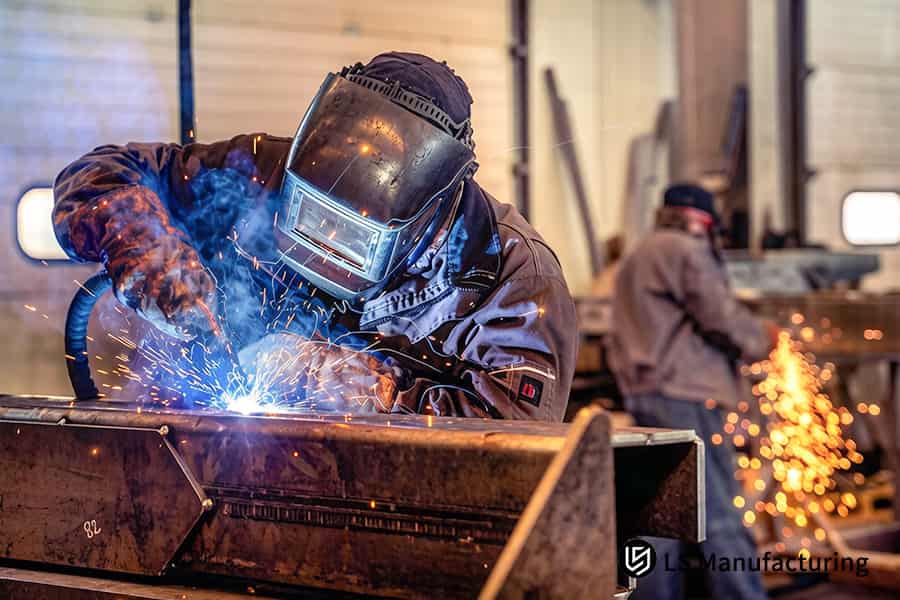
Figure 4: Assembling a 6061 aluminum support frame for factory automation with precision metal welding.
Why Is A Precision Metal Welding Manufacturer Essential For Semiconductor Cleanroom Frameworks?
The semiconductor cleanroom structure requires both rigidity and an ultra-low outgassing surface that is free from particles. Welded joints produce microscopic crevices and spatters that could become potential contamination sites. Being a precision metal welding manufacturer, our solution lies in ensuring a complete process chain from controlled welding through electropolishing finish. This guarantees that even the joint itself can meet cleanroom structures.
Precision Welding in a Controlled Environment
- Welding Process Selection: GTAW/TIG weldings with no spatters under positive pressure environment.
- Parameter Optimization: Optimization welding parameters to ensure smooth welding bead formation with little post-grinding needed.
- Inert Gas Purging: Argon gas purging in tubes to make sure that there would be no scaling in the future.
Achieving Electropolishing-Grade Surface Finishing
- Mechanical Finishing Sequence: Performing gradual grinding/polishing procedure of the welding spot and HAZ.
- Micro-crevice Elimination: This is about obtaining a finish identical to that of the base metal (Ra), which eliminates any microscopic crevices which may contain contaminants.
- Final Passivation: This chemical process ensures the restoration of the chromium oxide layer on the entire part, with low outgassing characteristics, a critical requirement in an ultra-clean metal welding.
Validation in a Cleanroom-Compatible Setting
- Controlled Assembly: Final assembly and examination done in an ISO Class 7 or above cleanroom.
- Performance Verification: Wipe testing to gauge particulate counts as per the IEST protocol, providing proof-of-concept verification for the controlled-environment welding and assembly.
Our end-to-end solution addresses the problem associated with the potential contaminant inherent in conventional fabrication. Our expertise as a precision metal welding manufacturer is evident from the fact that we incorporate spatterless welding technology coupled with mechanical polishing to electropolishing finish. It guarantees the structural integrity of the framework without causing any particle pollution, making our custom metal welding services relevant to this client’s requirement for an inert framework.
LS Manufacturing: Custom Welding Case Study—Heavy-Duty Vibrating Screen Frames For The Mining Industry
LS Manufacturing solved a critical problem of fatigue crackings in the frames of a vibrating mining screen with massive downtime associated with this issue. Joint design changes, automated metal welding, and heat treatment were used as solutions to the problem. In this regard, it is clear that we provide our customers with engineering metal welding services in situations where metal fabrication is not enough.
Client Challenge
One of the multinational companies faced fatigue cracking in A572 grade 50 steel joints of vibrating screens once every three months. Manual metal welding did not solve the problem due to poor joint penetration and stress accumulation at the corners of joints. As a result, the client experienced downtime costing $200,000 per day and interrupting an important production line.
LS Manufacturing Solution
Being a heavy duty welding manufacturer, we have modified the joint into a full penetration double-V grooved joint, thus allowing us to perform automated Submerged Arc Welding (SAW). After that we performed high-deposition metal welding along with full stress relieving process at 1150°F, addressing directly the residual stress leading to the development of fatigue cracks.
Results and Value
Our customized structural welding design, which has run continuously for over two years without any weld failures, has increased the lifespan by 400% while saving the client from a huge daily loss due to downtime. Such impressive results have enabled us to become an approved vendor on their worldwide list. Our performance earned us a $3 million contract.
This project highlights our technical prowess in handling complex and costly failures through an organized metallurgical-based method of analysis. Our approach guaranteed accuracy through designing the joint, automating the procedure, and removing any form of residual stress. The ability to solve problems through this method qualifies LS Manufacturing as a heavy duty welding manufacturer that collaborates with clients to achieve continuous operations and reliability metrics.
Achieve 4x lifespan for heavy equipment. Get a free welding process analysis for your project.

FAQs
1. Why should I choose LS Manufacturing as my heavy-duty welding manufacturer?
The firm holds both AWS and ISO qualifications. With a digital thermal management system, we guarantee the mechanical stability of each weld joint to offer maximum structural safety above industry standards.
2. What materials can your metal welding services handle for industrial projects?
The company focuses on welding heavy duty industrial materials, such as Q355B carbon steel, 300/400 stainless steels, AR400/500 abrasion resistant plates, and titanium alloys.
3. How do you control distortion during the structural metal welding of long components?
Using the science-based welding process sequence optimization and rigid hydraulic fixtures, combined with the inline laser welding straightening equipment after welding, makes sure that the geometry meets the specified tolerance values.
4. Can LS Manufacturing provide custom metal welding services for non-standard geometries?
Yes. We have a dedicated DFM (Design for Manufacturability) engineering team capable of optimizing weld bevels and joint designs based on your complex 3D models, thereby reducing unit costs while ensuring structural strength.
5. What NDT methods do you use for heavy-duty structural joining?
Depending on client requirements, we provide 100% coverage for Ultrasonic Testing (UT), Magnetic Particle Testing (MT), and Penetrant Testing (PT), as well as third-party Radiographic Testing (RT) reports.
6. Why is the pricing for your industrial metal welding services more competitive for bulk orders?
By utilizing robotic automated welding stations and leveraging economies of scale in raw material procurement, we are able to effectively reduce labor and administrative costs by 15–20% while maintaining high-precision tolerances.
7. Do you offer metal welding services for heavy structures intended for marine environments?
Absolutely. We specialize in marine-grade corrosion-resistant welding. Combined with specific multi-layer paint coating processes, we ensure that our weld seams remain maintenance-free for over 15 years, even in harsh salt-spray environments.
8. How can I request a quote from LS Manufacturing, a precision metal welding manufacturer?
Simply send your CAD/BIM models and welding specification requirements to our inquiry email address; our technical team will provide you with a detailed quotation proposal within 24 hours.
Summary
In heavy engineering, welding is far more than metal fusion—it is the ultimate commitment to structural safety. LS Manufacturing elevates heavy-duty fabrication with precise stress analysis and rigorous microstructural control, transforming traditional welding into a disciplined engineering practice. From initial welding consultations to the delivery of components with a 100% inspection pass rate, we are dedicated to minimizing your long-term operational costs, maintenance burdens, and safety risks.
Struggling with weld cracking or assembly deviations in heavy-duty parts? Don’t let substandard welding become a project time bomb. Please contact LS Manufacturing to obtain a structural welding process optimization plan, custom-tailored for you by our senior IWE engineers. Upload your specs to receive a free preliminary weld fatigue risk assessment—and maintain an unassailable edge in global infrastructure.
Your solution for zero-fatigue cracks in mining equipment. Request a consultation with our welding experts.
📞Tel: +86 185 6675 9667
📧Email: info@lsrpf.com
🌐Website: https://lsrpf.com/
Disclaimer
The contents of this page are for informational purposes only. LS Manufacturing services There are no representations or warranties, express or implied, as to the accuracy, completeness or validity of the information. It should not be inferred that a third-party supplier or manufacturer will provide performance parameters, geometric tolerances, specific design characteristics, material quality and type or workmanship through the LS Manufacturing network. It's the buyer's responsibility. Require parts quotation Identify specific requirements for these sections.Please contact us for more information.
LS Manufacturing Team
LS Manufacturing is an industry-leading company. Focus on custom manufacturing solutions. We have over 20 years of experience with over 5,000 customers, and we focus on high precision CNC machining, Sheet metal manufacturing, 3D printing, Injection molding. Metal stamping,and other one-stop manufacturing services.
Our factory is equipped with over 100 state-of-the-art 5-axis machining centers, ISO 9001:2015 certified. We provide fast, efficient and high-quality manufacturing solutions to customers in more than 150 countries around the world. Whether it is small volume production or large-scale customization, we can meet your needs with the fastest delivery within 24 hours. choose LS Manufacturing. This means selection efficiency, quality and professionalism.
To learn more, visit our website:www.lsrpf.com.