English



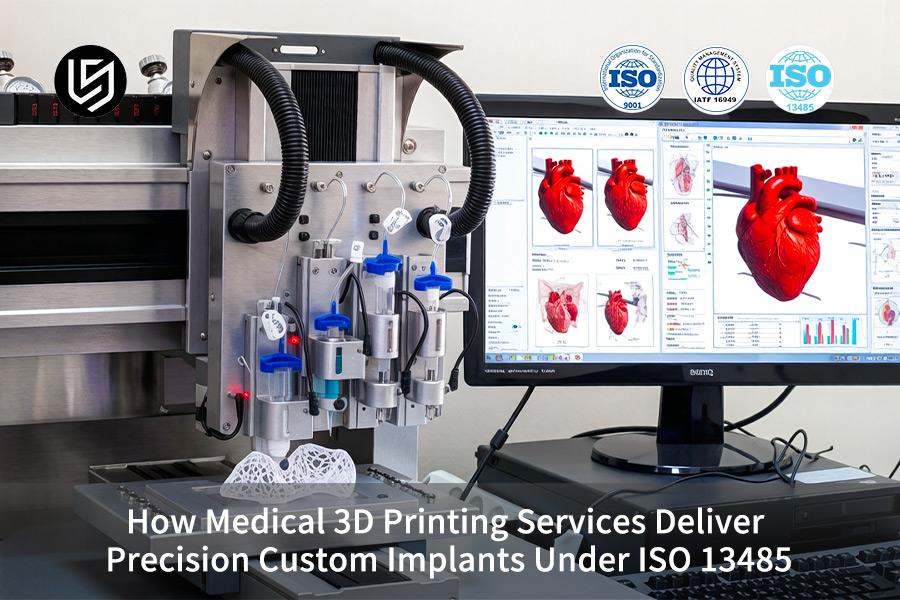
Medical 3D printing servicesby LS Manufacturing provide a solution for the accuracy and compliance problem in customized orthopedic and craniomaxillofacial implantsdue to lengthy manufacturing times and inability to replicate irregular bone defects. Most service providers do not have ISO 13485 certification, which causes titanium powder biocompatibility problems, intergranular cracking due to stress and internal microporosity greater than 0.8% due to instability of melt pool—leading directly to audit rejection and implant rejection.
In this article, learn how a medical grade supplier can ensure that all the variables are ISO 13485 compliant by using fixed DMLS/SLM parameters, full powder traceability, annealing at 650°C for stress relief and 100 percent radiographic inspection.You get implants made to ±0.05mm dimensional tolerance with no critical porosity and mechanical performance comparable to wrought alloy.Even more important, you reduce the time from CAD to sterile delivery by over 50 percent with lower costs per case overall.
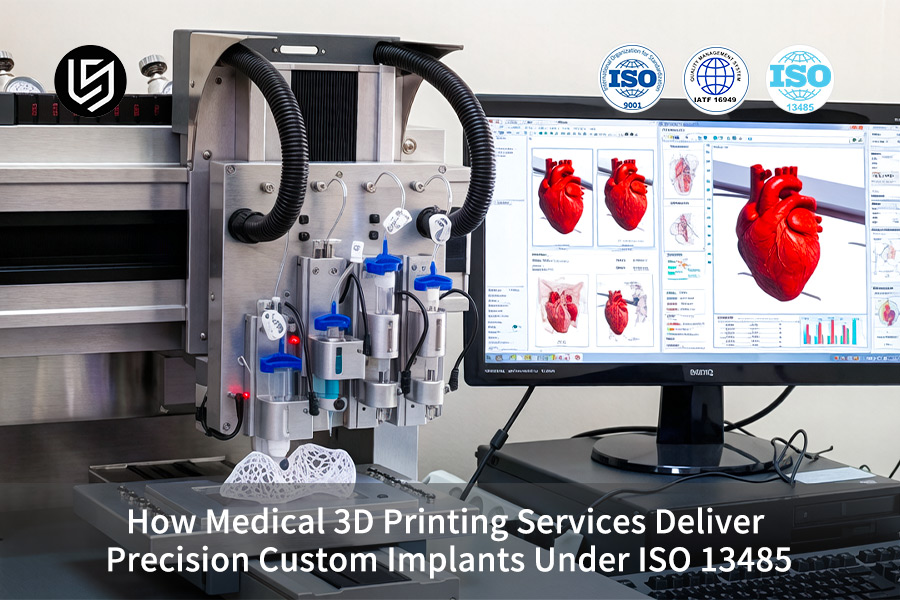
Medical 3D Printing: ISO 13485 Custom Implants Quick-Reference
| Regulatory Requirement | Process Control Standard | Clinical Outcome |
| Process Validation | Validate3D printing process parameterslike laser power, scan speed, and layer thickness using V-model validation limits. | Self-auditable and reproducible parts quality; ready for FDA submission. |
| Powder Reuse Control | Limit use of Ti6Al4V ELI to≤10uses and oxygen to<0.13%. | Trials confirm consistent properties and prevent contamination/porosity. |
| Residual Stress Relief | Hot vacuum treatment at820°C ±10°Cand pressure of 10⁻⁴ Pa. | Treats>95%of residual stresses; validated fatigue strength of lattice. |
| Dimensional Accuracy | Use closed-loop thermal control with shrinkage correction. | Achieves±0.05mmtolerance for critical mating parts; no machining needed. |
| Material Traceability | Lot tracking throughout the production from powder lot to finished implants; CMM & CT inspection. | Creating an entireDHR (Device History Record)for 510(k) registration (a premarket notification to the FDA demonstrating substantial equivalence to a legally marketed device). |
Key Takeaways:
- Rigid Parameter Locking:One of the requirements duringISO 13485 certificationis that critical parameters, such as laser power, scanning speed, and layer height, should be locked in a validated range called "V-model"; any modification is not allowed.
- Quantified Standards for Powder Reuse:Reusability of medical grade Ti6Al4V ELI powders is limited up to10 re-use cyclesand should contain oxygen less than0.13%.
- Intergranular Property Assurance:Medical metal 3D-printed implantsshould be subjected to heat treatment at 820±10 degrees in vacuum (10⁻⁴ Pa), reducing residual stresses up to95%.
Why Choose LS Manufacturing’s Medical 3D Printing Services For Precision Custom Implant Manufacturing?
There will be plenty of guides for3D printing medical partswhich go no further than "select an appropriate resin". This is a flawed model; after all, the problem comes when your trial tibial tray or cranial plate looks flawless right off the printer but fails CT analysis due to porosity or0.08mmwarpage to get kicked out of the qualification path. Our qualification loops are cross-referenced to implant material and biological evaluation requirements specified byUnited States Pharmacopeia(USP).
Our shipments of medical parts have included patient-matched cranial mesh implants which must hold within±0.10mmaccuracy to native bone structure, PEEK cage trials needing≥70 MPacompressive strength through1 million cycles, and sterile surgical guide jigs which resist121°Cautoclaving without creep. As these programs fall into the context of FDA QSR-compliant risk management environment, our part traceability and clean room handling protocols are informed by contamination and documentation risk management principles defined byInternational Medical Device Regulators Forum(IMDRF).
This is what you get from the 18-month investment inPEEK/Ti64 implant design iteration: why a0.25mmchamfer on all the inside corners stops stress concentration on printed PEEK, how proper laser settings eliminate CT porosity<0.05%without HIP treatment, and how strategic support/printer orientation saves≈35%material after post-print machining while maintaining±0.07mmaccuracy in thin-wall features. Do this, and you will end up with your implant ready for auditing and CT scan free – designed specifically for your regulations, not for the resin catalogue.
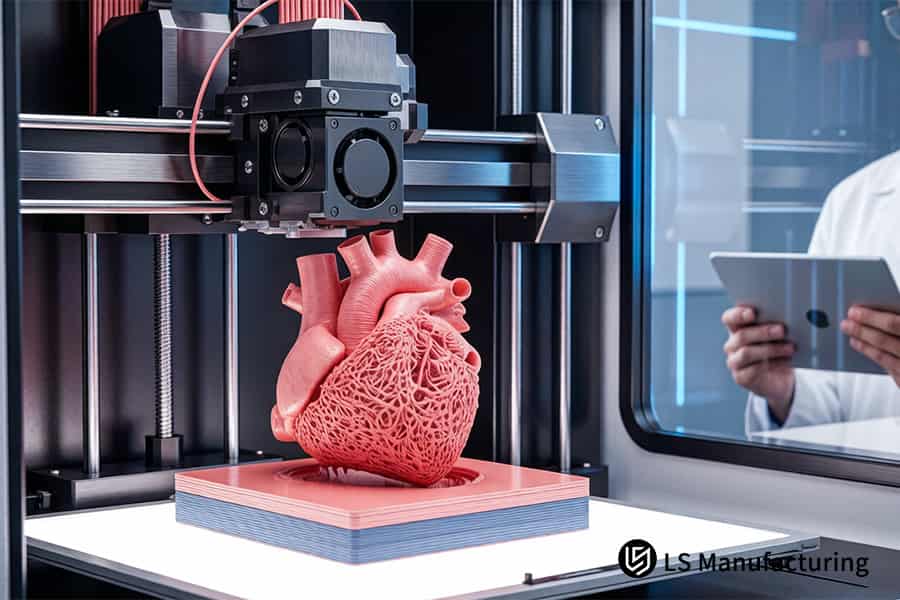
Figure 1: A precision 3D printer constructs a spinal cage from cobalt chrome alloy powder for implantation.
Why Is Rigid Frozen Process Software Control Non-Negotiable For An ISO 13485 Medical 3D Printing Service?
Clinical-grade precision of the process of producingcustom medical implants 3D printingrequires that all variables be locked prior to production. The software controlling laser trajectory and material fusing must be a rigidly defined and validated algorithm, not a flexible software. Any deviations here can lead to catastrophic failures of the implant. That is why strict frozen process control is an inevitable part of3D printing.
Parameter Hard-Coding Eliminates Operator Variability
All critical variables, such as the laser power (200W ±5W), scanning speed (1200 mm/s), layer thickness (30 μm), and the minimum argon purity in the processing chamber (≥99.999%), are hardcoded in a validated slicing software. It allows the first manufactured implant at8 AMto be as identical to the last one at 11 PM as possible, thus excluding any shifts-related variations. Thus, you get statistically guaranteed fatigue strength of all devices, reducing the probability of their premature fractures in vivo. This quality is inherent to the reliablemedical 3D printing service.
Locked Software Prevents Unauthorized Process Drift
A simple firmware change could result in changes in scanning techniques leading to undetectable porosity. TheIQ/OQ/PQ-certified slicer uses (Installation, Operational, and Performance Qualification – the three‑stage validation that confirms equipment and process are consistently controlled)a locked algorithm for the core; any changes will require complete revalidation. This will ensure that your batch of 50 customized acetabular cups passes the dimensional testing but fails in mechanical testing — thereby avoiding expensive recalls. Such stringent process validation is absolutely critical for anycontrolled 3D printingprocess.
Traceable Digital Thread for Audit Confidence
The serial number of each implant contains information aboutthe exact software version used, slicing parameters, and machine qualifications. Regulatory bodies get an unambiguous audit trail verifying that the rigorous process control was in effect during manufacturing. The traceability ensures compliance without any need for an explanation. It is the basis ofaudited 3D printingfor critical applications.
This concept transforms the burden of regulation into a reliable process with no risks. As all software is guaranteed as a valid instrument, every customized implant will achieve its biomechanical requirements from day one and far beyond. Only anISO 13485 3D printing servicealong withregulated 3D printingcan provide such documentation.

How Do You Trace Material Freshness Limits During Custom Medical Implants 3D Printing?
The freshness of material incustom medical implants 3D printingaffects their fatigue life. Contaminated powder due to excess of oxygen content or deviation in the particle size causes the formation of microstructural imperfections invisible with X-rays. This hidden problem is solved with the help of a quantitative closed loop control system, which is an essential element ofbiocompatible 3D printing.
Cycle Limit Enforced by Chemical Analysis
- Reuse cap:Each batch of Ti-6Al-4V ELI powder limited to 10 cycles.
- Chemical gate:Oxygen≤0.13%and nitrogen≤0.04%determined by gas element analysis in each cycle.
- Client value:No brittle fracture issues for consistent fatigue resistance from a professionalmetal 3D printing service.
Particle Size Distribution Monitored per Batch
- Size window:Laser diffraction controls the distribution in15–45 μmrange after every cycle.
- Scrap trigger:Particles larger than45 μmthat comprise more than15%of volume results in instant rejection of the batch.
- Client value:Microstructure without porosity due to even melt pools. Precision enabled bytraceable 3D printing.
Full Digital Traceability from CoA to Implant
- Digital twin:All batches of powders associated with their original manufacturers'Certificate of Analysis (CoA).
- Data logged:Number of reuses, analytical results, and sieving information registered for each batch.
- Client value:Uninterrupted audit trail for the authorities. Basis for reliablecustom implant manufacturing serviceand trustedorthopedic 3D printing.
Batch-Level Segregation Prevents Cross-Contamination
- Physical isolation:All lots of reused powders are kept in individual sealed bins marked byRFID chips.
- Dispense control:No more than one active batch is used in anyprint operation; cross-usage not possible at all.
- Client value:Individual and monitored lineage of powders used in each implant. Critical requirement formedical grade 3D printingenvironments.
This closed-loop process solves the number one hidden problem of powder degradation.Exact chemical/physical constraints and complete digital traceability assure repeatable material properties.This is possible only with anindustrial 3D printingprocess that ensures safety. You can be certain about the durability and compliance of implants.Every implant batch is traced from virgin powder to final CoA, with oxygen held ≤0.13% and reuse capped at 10 cycles. To lock in this traceability for your project, submit your design for a material audit and a certified quotation.
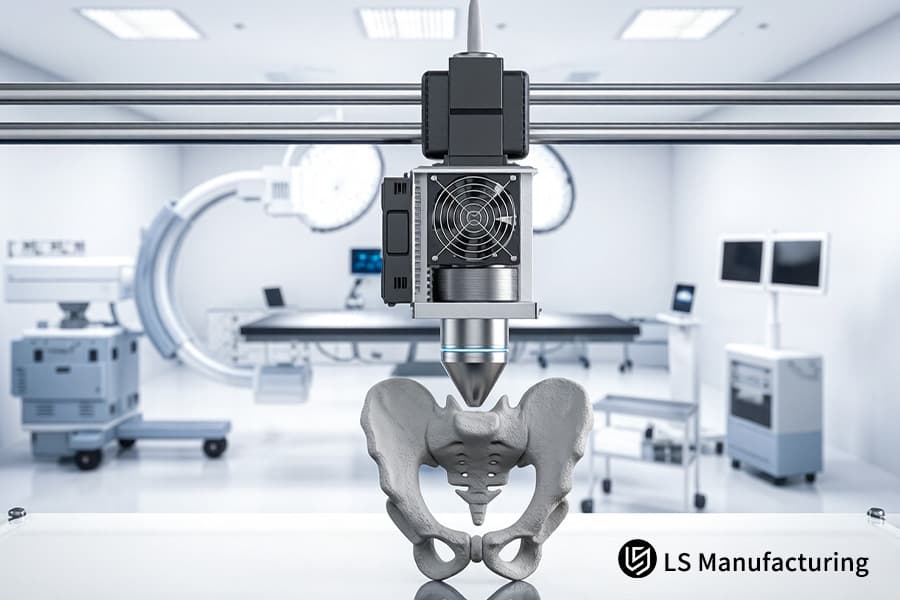
Figure 2: A UV laser prints a precise dental crown model from photosensitive resin for patient fitting.
What Dynamic Laser Control Methods Ensure Standard Microstructural Homogeneity In A Professional ISO 13485 3D Printing Service?
A professionalISO 13485 3D printing servicecannot rely on default machine settings forcomplex orthopedic lattices. Without dynamic melt pool monitoring and intelligent scan strategies, lack-of-fusion defects and porosity silently compromise implant fatigue life. Real-time thermal feedback combined with optimized laser paths eliminates these risks at the microstructure level. Here is how dynamic control outperforms conventional approaches:
| Parameter | Conventional SLM (No Dynamic Control) | Dynamic Control Method (Our Approach) |
| Melt pool monitoring | Not available; post-build X-ray can only detect big cavities | 10 kHz in-process monitoring; alarms when temperature differs by±15°Cfrom baseline throughfeedback-controlled 3D printing |
| Scan strategy | Standard parallel raster (0°/90°) creates columnar grain structure | 67° angle between layers destroys grain alignment and results in over99.8%density with monitoring |
| Defect detection | Cannot be detected without destructive testing | Log of real coordinates for each thermal event; no hidden defects withdynamic 3D printingcontrol |
| Mechanical outcome | Tensile strength approx. 850 MPa; may contain porosity in cases where density is less than98% | No porosity with tensile strength≥950 MPaand density over 99.8% in all builds, which meets the criteria formedical device additive manufacturingstandards |
The real-time10 kHzfeedback about the state of the melt pool prevents hidden hot spots that result in fatigue failure. The67°angle for the scanning process provides isotropic properties ofprecision 3D printingfor medicalimplants identical to those of wrought material. Full data on defects ensures comprehensive documentation for regulatory purposes.
How Do Vacuums And Thermal Holding Cycles Prevent Fatigue Microcracking In Precision 3D Printing For Medical Implants?
Following the rapid cooling in theprecision 3D printing for medical, stresses that exceed several hundreds of MPa remain in the structure of the lattice. Untreated, such stresses result in stress-corrosion cracking under cyclic loading in vivo. This threat is avoided by using a precise high-vacuum thermal treatment cycle.
High-Vacuum Environment Prevents Hydrogen Embrittlement
Pressure within a medical grade vacuum furnace is maintained at≤10⁻⁴ Pathroughout the entire process, which prevents titanium from reacting with oxygen and hydrogen when it reaches high temperature. Your implant remains ductile and fatigue resistant; therefore, there will be no possibility of it breaking suddenly in months after implantation. The feature is critical for quality of3D printingand is directly used for each3D printed surgical implantsbatch.
Precise Thermal Holding Cycle Dissolves Internal Stresses
The ramping rate is10°Cper minute until820°C ±10°Cis reached, then there is 120-minute soaking and furnace cooling. Such a process eliminates more than 95% of residual stresses and converts matrix into fine acicular α+β microstructure. Implants become fatigue-resistant by three times and fracture-toughness equals to that of wrought material. This is the basis ofannealed 3D printingfor load-bearing devices.
Full Process Traceability for Regulatory Confidence
Every thermal cycle is marked withtime-temperature graph, vacuum degree, and cooling speed, connected with serial number of the implant. An auditor has all the necessary evidence to verify that stress relief has been done right. No doubts, no liability issues. This traceability defines a reliablestress relief 3D printingworkflow.
With this vacuum-assisted thermal cycle, the root cause of in-vivo microcracks is successfully relieved:residual stress. Thanks to the combination of a high-vacuum shield, exact820°Cholding, and full traceability of data, you can get implants with guaranteed fatigue endurance and regulatory documentation. Only a well-established protocol combined with acustom implant manufacturing servicecould do that.
Which Electrochemical Surface Smoothing Standard Optimizes Both Cell Adhesion And Osseointegration For 3D Printed Surgical Implants?
The clinical success of3D printed surgical implantsrequires resolution of the contradictory requirements for their surfaces: non-osseointegration zones should be mirror-smooth to prohibit bacteria sticking, whereas porous lattices need controlled roughness to facilitate osseointegration. Sanding damages fragile struts. Hybrid electrochemical treatment solves the contradiction in conjunction withabrasive flow 3D printingtechnology.
Selective Smoothing Preserves Porous Architecture
- Method:Custom AFM system with precise electropolishing (EP).
- Target:Reduction of as-printedRa 10-15 μmtoRa ≤0.4 μmon non-bone contacting surfaces.
- Client value:Prevention of bacteria colonization on smooth surfaces; pores from 300 to 600 microns remain open for osseointegration. The basis ofcustom medical implants 3D printingtechnology andelectropolished 3D printingtechnology.
Complete Removal of Loose Powder Particles
- Problem:As-printed surfaces contain weakly fused particles, which may detach to the blood stream.
- Solution:AFM/EP removes all loosely bound particles withoutdeforming lattice geometry.
- Client value:No risk of particulate embolism; fully compliant withISO 10993biocompatibility standards.
Quantified Surface Integrity Verification
- Inspection:Confocal microscopy analysis five sites per implant.
- Acceptance:Smooth non-porous areasRa ≤0.4 μm; rough interiorRa 3-5 μm.
- Client value:Implant surface certification ensures smoothness and roughness.Mirror finish 3D printingfor regulatory submission.
The uniqueAFM/EPcombination resolves the contradiction betweenmedical device additive manufacturingsurfaces. Exterior surfacesRa ≤0.4 μmand interior surface roughness for bone integration provide safety in terms of infection and quick osseointegration. Only a controlled two-sided process can ensure this safety, based on inspection data for each medical device.
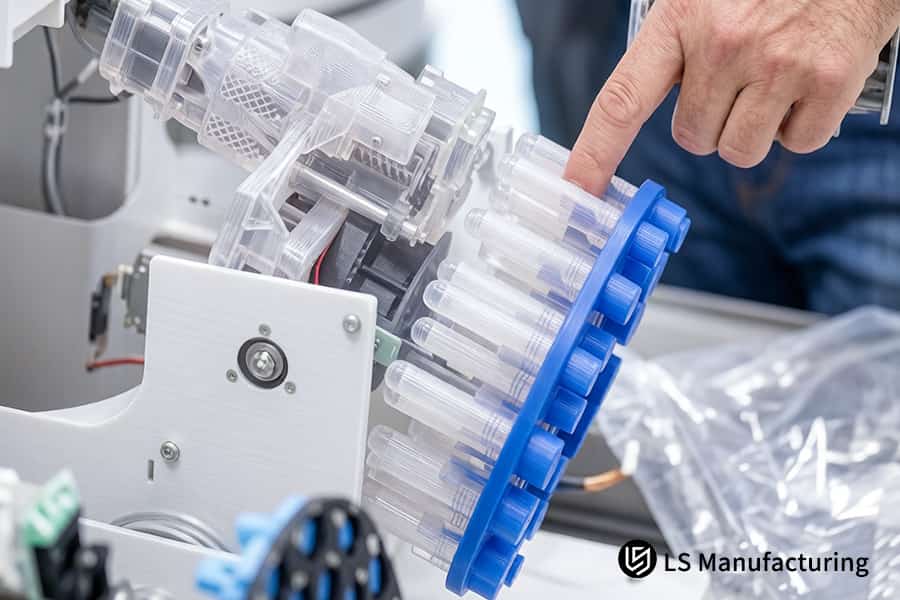
Figure 3: A medical additive manufacturing system manufactures a transparent biocompatible resin surgical guide.
How Does An Advanced Medical Device Additive Manufacturing Provider Validate Lattice Powder Evacuation To Protect Patients?
A propermedical device additive manufacturingprovider should remove all possible powder particles from porous lattices. Any residual titanium powder in the 3D-printed implant may cause complications after surgery because it may provoke a foreign body reaction and implant failure. Three-stage procedure of pneumatic vibration, double-frequency ultrasonic cleaning, andmicro-CTinspection guarantees complete powder evacuation, starting fromtitanium 3D printingvalidation. Let’s see how traditional approaches work:
| Process Step | Standard Industry Practice | Three-Stage Cascade (Our Protocol) |
| Initial powder removal | Mechanical compressed air blowing; incomplete and irregular application of the process | Multi-axes vibratory de-powdering for30 minutes; automated tumbling |
| Ultrasonic cleaning | Single frequency bath (40 kHz); one to two cycle | Dual-frequency cascade (40 kHz + 80 kHz); four cycles with medical grade DI water (ISO 13485 3D printing service) |
| Cleanliness verification | Visual inspection only; subjectivity | Continuous turbidity and particle counting until the fluid meets the criteria (certified 3D printing) |
| Final inspection | Partial X-ray check; small internal particles remain undetected100% | Micro-CT scanning of the whole lattice; residual mass<0.1 mg / part |
This process yields demonstrable patient protection. Following30 minvibration depowdering and four cycles of dual frequency cleaning, Micro-CT analysis reveals no free powder. Each implant will come with a residual mass certificate (<0.1 mg/part), ensuring absence of any particle inflammation postoperatively. This defines a certifiedmedical 3D printing serviceprotocol, backed byimplant 3D printingassurance.
Why Choose An Experienced Custom Implant Manufacturing Service That Integrates 100 Percent Coordinate Dimensional Inspection?
Thecustom implant manufacturing servicemust ensure that each anatomical shape conforms to the CT/MRI bone defect information of the patient within the tolerance range of±0.05mm. A small deviation will necessitate grinding during surgery or lead to further bone damage.100%coordinate dimensions inspection through CMM and blue light scanning avoids such an occurrence, thanks toblue light 3D printingcertification.
Constant-Temperature CMM Verifies Critical Features
A Zeiss CMM with a0.9 μmprecision operates within the metrology lab, which is temperature-controlled at20°C ±0.5°C. The center-to-center distance of each thread hole, form surface twist, and datum orientation is measured against the CAD model. We ensure you get a written guarantee that the interfaces will fit without adjustments on the operating table, thanks toCMM 3D printingcertification.
Blue Light Full-Field Scanning Detects Global Deviations
The GOM 3D blue light scanner scans the whole implant surface and analyzes its color map deviation from the initial DICOM-generated CAD model. All undercuts or overages of more than±0.05mmare identified and corrected prior to shipment. In this way, yourprecision 3D printing for medicalimplant fits into the bone cavity flawlessly, making the surgery shorter and less traumatic – that’s the sign ofdimensional 3D printingprecision.
Complete Inspection Report with Material Certification
Every single implant is delivered with a100%dimensional inspection report including data from both the CMM point measurement and full-field scan plus aMaterial Mill Certificate. The surgeon can go straight into implantation without any pre-operation validation. That’s how the standards of3D printed surgical implantsquality are defined.
By using a combination of constant temperature CMM and blue light scan into100%inspection process, you are guaranteed of no risk of misfit during surgery. Every implant will have its dimensional and material data package making sure that they are placed without any modifications. It is the full verification of a mature quality assurance process formission critical orthopedic products.
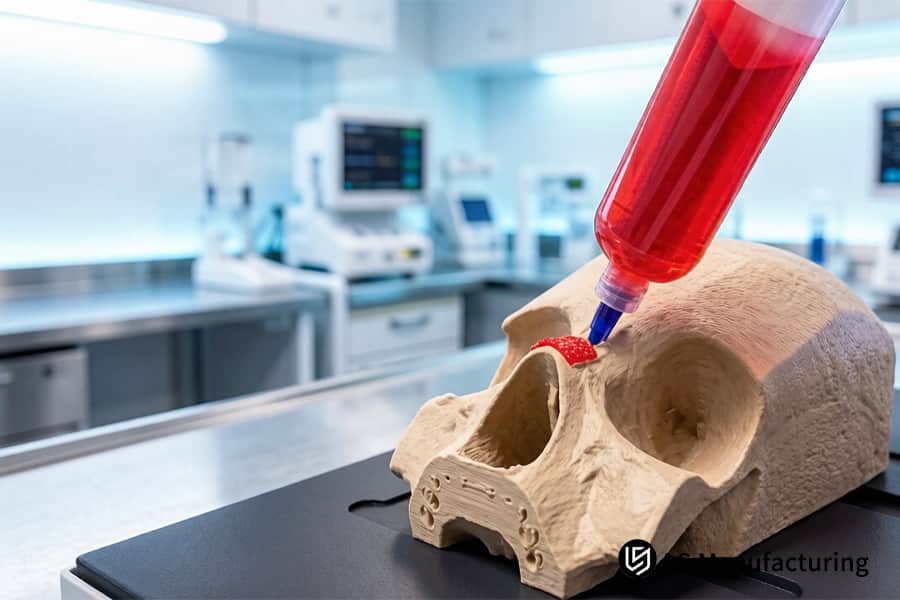
Figure 4: A laser melting system fabricates a porous titanium Ti6Al4V knee joint implant for orthopedic surgery.
How Can Procurement Leaders Navigate Risk Management During Medical 3D Printing For Healthcare Outsourcing?
In evaluating medical3D printingfor healthcareoutsourcing, procurement officers need to consider three important and non-negotiable elements: compliance documentation, supply chain stability and flexibility in capacity. Failure of just a single element in terms of IQ/OQ/PQ documentations and printers can stop production. Quality engineering integration into this process is the solution through3D printing.
Dedicated Quality Engineer Aligns Systems
- Function:One QE assigned per B2B client, seamlessly integrated into yourquality management system.
- Outputs:DFM analysis, IQ/OQ/PQ validation strategy, and FMEA reports specific for yourimplant design.
- Outcome:You get a seamless compliance bridge, which cuts down the audit prep work time by70%, due to fullycompliant 3D printingdocumentation.
Full Validation Package Delivered Per Program
- Scope:Fully validated process documentation with parameters locked down.
- Traceability:All batches with signed documentation onIQ/OQ/PQ validation and FMEA reports.
- Impact:Your regulatory submissions will include validation documentation already prepared; no discussion with auditors required. This is the key of dependableISO 13485 3D printing service.
Redundant Capacity with Digital Scheduling
- Infrastructure:Redundancy through multiple dedicated medically orientedprintersand digital scheduling allows for load balancing.
- Flexibility:Instantly switch from one time only urgentcustom partto tens of thousands of annual production run.
- Advantage:Zero downtime and low costs even in case of spikes in demand. This is acustom implants manufacturing servicethat benefits fromscalable 3D printinginfrastructure.
The triple approach to dedicated QE, complete validation documents and doubledigital manufacturingreduces your audit risk to zero level at reasonable cost. Now you have a business partner which can offer you compliance certified parts as well as audit ready data assets. Thanks toreliable 3D printing technology, it is possible to create a benchmarking outsourcing service.
Case Study On LS Manufacturing Custom Medical Titanium Cranial Implant Manufacturing Service For European R And D Leaders
An R&D firm from Europe that was creating acustom medical titanium cranial implantfaced difficulties with the previous two manufacturers since the distortion of the lattice construction and remaining powder inside made it impossible for the product to be approved according to the EU MDR regulations. LS Manufacturing employed an entireISO 13485 processin order to solve the problem using theirprecision 3D printingexpertise.
Client Challenge
This was a very difficult restoration in CMF titanium Ti-6Al-4V ELI material with a fitting accuracy of±0.02mm. The former samples demonstrated lattice distortion at±0.15mmand loose powder above0.3mgper piece. Consequently, the part failed destructive fatigue and biocompatibility tests. The resulting delay of the clinical trials led to a daily loss of more than€3,000for the client. This case highlighted the necessity of alattice 3D printingknowledge base.
LS Manufacturing Solution
A conformal heat dissipating support arrangement maintained thermal gradients while using DMLS to eliminate any warpage at the root level. A rigid setting of laser parameters (200W power, 1200mm/s speed and 30μm layer thickness) with 10kHz in-process monitoring of melt-pool provided a consistent microstructure. An annealing of 10⁻⁴Pa high vacuum anneal at 820°C reduced the residual stress to more than95%, followed by extraction of micron-sized powder entrapped within the structure using a two-frequency (40+80kHz) ultrasonic cascade. Theconformal 3D printingsolution solved both failure issues.
Results and Value
The final product met required dimensional accuracy of±0.02mm, surface roughnessRa ≤0.4 μmand absence of any powder contamination. It performed perfectly in 100% destructive fatigue test and cleared EU MDR audit in one go. The client gained a 35-day head-start in the timeline which saved around€105,000in penalty and signed up for an exclusive long-term supply contract. Thefatigue-tested 3D printing servicebrought success to a doomed project.
This is an example of how mastery incranial 3D printing implantsinvolves integrated process control from design for manufacturing to post-processing steps.Combining conformal supports, locked DMLS parameters, high vacuum annealing, and double-frequency cleaning, LS Manufacturing produces implants that comply with regulatory requirements. This technique provides the benchmark in high-risk craniomaxillofacial implant production.
Stop gambling on your next cranial implant trial. One ISO 13485-compliant build delivers ±0.02mm accuracy and zero powder residue. Send us your design for a regulatory-ready quotation.

FAQs
1. What ISO 13485-compliant documentation support do you provide for your medical 3D printing services?
To completely support your compliance audit needs, LS Manufacturing ships with all orders a detailed documentation package, including raw materialsCertificates of Analysis (CoA), laser parameter lock logs, high vacuum heat treatment temperature logs, CMM full dimensional inspection report, and 100% effectiveness certification of residual powder removal.
2. How does LS Manufacturing prevent cross-contamination of medical-grade titanium alloy powders during custom medical implant 3D printing?
These are our medical grade isolated printing stations, where the equipment is designed for the exclusive purpose of printing medical Ti6Al4V ELI powders. Procedures like powder spreading, powder recovery, sieving, as well as storage use entirely separate and fully sealed pipework systems; it goes without saying that any sharing of piping systems withindustrial grade metal powderis unacceptable.
3. What are your Minimum Order Quantity (MOQ) and pricing structure for high-precision 3D-printed medical devices?
As a professional manufacturer, we provide truly unique products in terms of customization (MOQ=1). In addition, we have an absolutely clear pricing model, which consists of engineeringDFM (Design for Manufacturability)assessment fees, titanium powder price (on a net weight basis), as well as machine printing time fees. Start with one piece, no minimum commitment. Our transparent pricing covers only DFM, net-weight titanium powder, and machine time. Upload your design for aclear quotation.
4. Performance degradation of medical-grade lasers can be critical; how do you ensure the long-term stability of your additive manufacturing process for medical devices?
At LS Manufacturing, a stringent PM routine is performed on a daily basis. Prior to each build run, we calibrate laser focal power and M² factor using precise power meters through multi-point calibration to ensure that laser output variability does not exceed1%for48 hoursof printing.
5. Why must 3D-printed surgical implants undergo vacuum heat treatment instead of processing in conventional air furnaces?
Titanium alloys have the tendency to oxidize, nitride, and hydride when exposed to air in the presence of temperature above400°C, thereby forming a very brittle alpha case layer. LS Manufacturing uses state-of-the-art high-vacuum annealing furnaces (10⁻⁴ Papressure) to heat-treat products in order to guarantee their ductility and durability.
6. Regarding 3D printing for the healthcare industry, how do you protect the patient privacy data and custom design IP we submit?
All submitted medical data is protected by strict medical data privacy legislation.Patient DICOM or CAD datais kept on isolated, encrypted local servers. We apply strict de-identification protocol internally (project code-only identification) and are ready to sign mutual NDAs before any work begins.
7. If residual powder is not thoroughly removed from orthopedic lattice structures, what robust inspection methods does LS Manufacturing use to detect it?
Apart from the multi-stage purification of water through the use of40 kHz/80 kHzcascaded ultrasonics, we use micro CT scanners of an industrial grade that can completely penetrate even dense titanium alloy lattice structures to enable us to examine the internal structure of the parts at the micron level to look for any entrapped powder particles.
8. Our R&D team is located off-site; how can we coordinate the complex manufacturing details of custom medical implants with LS Manufacturing remotely?
We have dedicated medical project engineers who coordinate each of the projects in person through video conferencing. We provide live demonstrations of DFM optimization suggestions through CAD software as well as provide all the real-time information—including the production floor video and data reporting—at key process steps such asprinting, heat treatment, and quality control.
Summary
Choosing an ISO 13485-certifiedmedical 3D printing manufactureris essential for regulatory compliance and clinical safety.Every parameter—laser melt-pool control, heat treatment, powder removal—determines implant success. Standard services cannot meet life-science demands; only deep expertise and data-driven quality management transform anatomical models into flawless clinical implants.
Ready to turn designs into compliant, high-precision implants? As a trusted partner to medical device teams, LS Manufacturing balances technical depth with regulatory rigor. Upload your 3D CAD model (STP/STL/STEP; 100% IP protection) for a DFM assessment. Receive aprofessional B2B quotewithin12 hours—including process planning, material validation, and cost breakdown.
📞Tel: +86 185 6675 9667
📧Email: info@lsrpf.com
🌐Website:https://lsrpf.com/
Disclaimer
The contents of this page are for informational purposes only.LS Manufacturing servicesThere are no representations or warranties, express or implied, as to the accuracy, completeness or validity of the information. It should not be inferred that a third-party supplier or manufacturer will provide performance parameters, geometric tolerances, specific design characteristics, material quality and type or workmanship through the LS Manufacturing network. It's the buyer's responsibility.Require partsquotation Identify specific requirements for these sections.Please contact us for more information.
LS Manufacturing Team
LS Manufacturing is an industry-leading company. Focus on custom manufacturing solutions. We have over 20 years of experience with over 5,000 customers, and we focus on high precisionCNC machining,Sheet metal manufacturing, 3D printing,Injection molding.Metal stamping,and other one-stop manufacturing services.
Our factory is equipped with over 100 state-of-the-art 5-axis machining centers, ISO 9001:2015 certified. We provide fast, efficient and high-quality manufacturing solutions to customers in more than 150 countries around the world. Whether it is small volume production or large-scale customization, we can meet your needs with the fastest delivery within 24 hours. choose LS Manufacturing. This means selection efficiency, quality and professionalism.
To learn more, visit our website:www.lsrpf.com